Marrying a Thai national: wedding, visa, property and land on Koh Phangan

On this page7
Thomas and Nok married in a beautiful ceremony in Ban Tai, monks, family and dowry included. Two years later, applying for a marriage visa, Thomas found out they were not married in the eyes of the law: nothing had ever been registered at the amphoe.
Marrying a Thai national changes a lot: your visa, your rights over the couple's property, the house and land, inheritance. On Koh Phangan, where many mixed couples live in a house in the Thai spouse's name, it pays to know these rules before you sign anything.
How do you marry legally in Thailand?
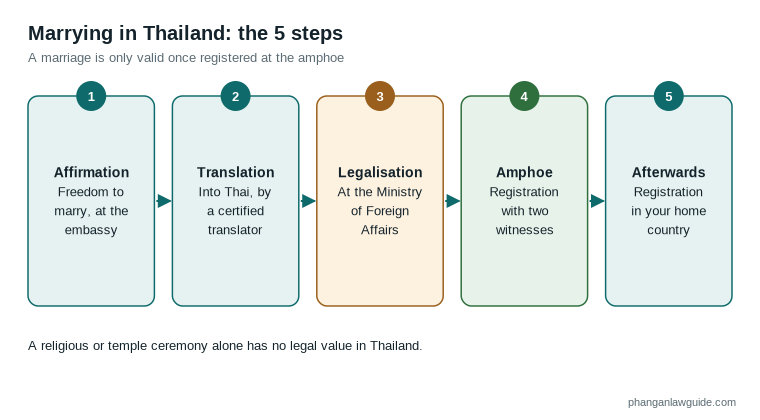
- The affirmation of freedom to marry. The foreigner gets it from their embassy or consulate in Thailand. It confirms they are free to marry. Many amphoes only accept an affirmation under 3 months old.
- Translation. The affirmation and passport are translated into Thai by a certified translator.
- Legalisation. The translations are legalised by the Department of Consular Affairs of the Ministry of Foreign Affairs, in Bangkok or a regional office.
- Registration at the amphoe. The couple goes to the district office, for example Koh Phangan's, with two witnesses. The Thai spouse brings their ID card and a copy of their house registration. The marriage certificate is issued in Thai.
- After the wedding. Have the certificate translated and, depending on your country, register the marriage with your consulate. French citizens, for instance, should get a certificate of capacity to marry before the ceremony so the marriage can be transcribed.
Since 23 January 2025, Thai law recognises same-sex marriage, with the same steps.
The traditional ceremony, with the dowry (sin sod), remains a family matter: it has no legal value until the marriage is registered.
Which visa with a Thai spouse?
Marriage lets you stay in Thailand on a renewable one-year extension of stay, based on a Non-Immigrant O visa.
- Money: 400,000 THB in a Thai account in your name, held for 2 months before the first application and 3 months before each renewal; or 40,000 THB monthly income, proven by an embassy letter or 12 months of transfers. Some offices accept a combination.
- No minimum age, unlike retirement (50).
- Home visit and photos: immigration often asks for photos of the couple at home and may visit.
- Work: a marriage extension lets you apply for a work permit, which retirement does not.
- Fees: 1,900 THB per extension, plus 90-day reports and a re-entry permit before each trip.
Who owns the couple's property?
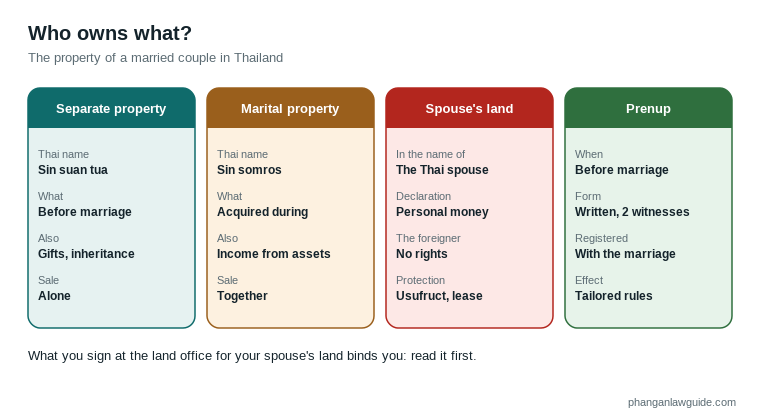
The Thai Civil and Commercial Code distinguishes two kinds of property:
- Separate property (sin suan tua, section 1471): what each spouse owned before marriage, personal belongings, and what they receive by gift or inheritance. Each manages it alone.
- Marital property (sin somros, section 1474): what is acquired during the marriage, plus income from separate property. Property acquired during the marriage is presumed marital. Selling or mortgaging marital real estate needs both spouses' consent.
A prenuptial agreement can set other rules. It must be in writing, signed before two witnesses and registered together with the marriage at the amphoe. Once married, it is too late to make one without going to court.
Can you buy land in your Thai spouse's name?
Yes, but with an important consequence. A foreigner cannot own land, not even jointly with a spouse. When a Thai national married to a foreigner buys land, the land office asks both spouses to declare in writing that the money used is the Thai spouse's separate property.
By signing, the foreigner acknowledges having no rights over the land: they are not a co-owner, and the land will not be divided in a divorce. If the money really came from the foreigner, the Thai spouse risks being treated as holding the land on behalf of a foreigner, which the Land Code punishes.
To protect themselves, the foreigner can have registered in their name at the land office:
- a usufruct, often for life, to keep living in the house;
- a 30-year lease on the land;
- a superficies over the house.
Note: between spouses, a usufruct granted during the marriage does not fully protect you in a divorce. A will usefully completes these protections.
What happens on divorce or death?
- Divorce by consent: if the marriage was registered in Thailand, spouses who agree can divorce at the amphoe. Otherwise it goes through the court.
- Division: marital property is in principle split equally. Separate property stays with each spouse, including land declared as the Thai spouse's separate property.
- Death: without a will, the surviving spouse inherits alongside children and other statutory heirs. A foreigner inheriting land must in principle sell it within a period set by the land office.
Frequently asked questions
Is a temple wedding valid in Thailand?
No. Only registration at the amphoe (district office) makes a marriage legal. A religious or traditional ceremony alone has no legal value.
Which documents do you need to marry a Thai national?
The foreigner provides an affirmation of freedom to marry from their embassy, translated into Thai and legalised by the Ministry of Foreign Affairs, with their passport. The Thai spouse brings their ID card and house registration.
How much money do you need for a Thai marriage visa?
400,000 THB in a Thai account, held for 2 months before the first application and 3 months before renewals, or 40,000 THB of monthly income.
Can a married foreigner own land in Thailand?
No. Land can be bought in the Thai spouse's name as separate property, but the foreigner must declare having no rights to it. They can protect themselves with a registered usufruct, lease or superficies.
Can you make a prenuptial agreement in Thailand?
Yes, provided it is in writing, signed before two witnesses and registered together with the marriage.
Does marriage let you work in Thailand?
A marriage-based extension of stay lets you apply for a work permit, unlike a retirement extension.
Sources
- Tilleke & Gibbins: marrying a Thai citizen, the steps
- GOV.UK: confirming you are free to marry in Thailand
- Thai Law Online: marriage visa (Non-O) 2026, 400,000 THB and extension
- Land Department: land acquisition by Thais with a foreign spouse
- Siam Legal: separate and marital property (sections 1471 to 1474)
- Thai Law Online: the land office confirmation letter
Share
Related guides
FamilyInheritance and a Thai willThai wills for foreigners, statutory heirs, the court and the estate administrator, inheriting a condo, land or a… GlossaryNon-O visa: definitionThe Non-Immigrant O (Non-O) visa is the entry route for retirees aged 50+ and spouses of Thais: 90 days, then…
 GlossarySuperficies: definitionThe right of superficies (sections 1410 to 1416) lets a foreigner own a house built on Thai land: term, registration…GlossaryUsufruct: definitionUsufruct (sections 1417 to 1428) gives the right to use property and take its income, often for life: what it…