Chanote: the Thai freehold land title, explained

"Sea-view land with Chanote." On Koh Phangan, those words push the price up, and rightly so: it is the most secure title. You still need to know how to read and check it.
What is a Chanote?
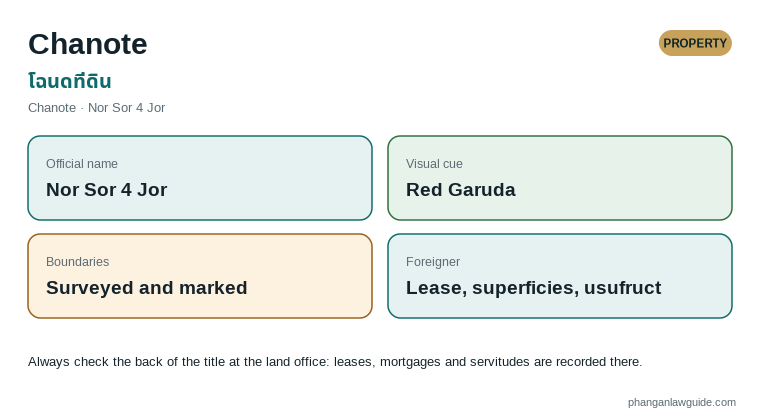
The Chanote is issued by the Land Department after a precise survey of the plot. It establishes full ownership: the owner can sell, lease, mortgage or grant real rights over the land. The front describes the plot (number, area in rai, ngan and square wah, map); the back lists every registered transaction: sales, leases, mortgages, servitudes.
A foreigner cannot own land in Thailand. With a Chanote, however, they can register a 30-year lease, a superficies to own the house, or a usufruct.
Why does it matter on Koh Phangan?
On the island, many plots only have a Nor Sor 3 Gor or no title at all: forest-classified hills, old concessions, public beaches. Listings saying "upgrade to Chanote in progress" often hide untitled land. A genuine Chanote sharply reduces the risk of boundary disputes or encroachment.
Frequently asked questions
Can a foreigner own a Chanote?
No. A foreigner cannot own the land, but can register a 30-year lease, a superficies or a usufruct on Chanote land.
How do you recognise a Chanote?
It bears a red Garuda at the top and the words Nor Sor 4 Jor. Its plot is precisely surveyed and marked on the ground.
Can a Chanote be fake or disputed?
Yes, it happens. A certified copy and a check at the land office, with the markers verified on site, remain essential.
Sources
Share
Related guides
 GlossaryNor Sor 3 Gor: definitionThe Nor Sor 3 Gor is a confirmed possession right, very common on Koh Phangan: what it allows, its limits compared…GlossarySor Por Kor: definitionThe Sor Por Kor 4-01 is land-reform farmland allocated to a Thai farmer: it cannot be sold or leased, and cheap…GlossaryRegistered lease: definitionA lease of more than 3 years must be registered at the Thai land office and cannot exceed 30 years: the rules, the…PropertyChanote vs Nor Sor 3 Gor: which land title?Chanote, Nor Sor 3 Gor, Nor Sor 3, Sor Kor 1, Por Bor Tor 5: what each Thai land document is worth on Koh Phangan,…