Koh Phangan nominee crackdown explained (2025–2026): what is happening and what to do

On this page9
- What is a nominee structure, and what is still legal?
- How did the crackdown unfold on Koh Phangan?
- How do investigators spot a nominee?
- What penalties do you face?
- What does the DBD check when a company registers or changes?
- You own a villa or a business through a Thai company: what should you do?
- Buying now: how do you avoid the trap?
- FAQ
- Sources
One morning in May 2026, official cars pulled up outside a villa company in Chaloklum. The Prime Minister stepped out in person and ordered a financial investigation. Ten days later, 32 companies on the island were raided and 22 foreigners arrested. Many owners then realised that the "standard" structure used to buy a villa on Koh Phangan could be a criminal offence.
This guide explains, in plain English, what is targeted, what is still legal, how to tell whether you are exposed and what to do this week.
What is a nominee structure, and what is still legal?
Thai law reserves land ownership for Thai nationals, and many activities (restaurants, hotels, tours, rentals, retail) for Thai-majority companies. A nominee structure gets around these rules: a Thai company is set up, Thai individuals appear as majority shareholders on paper, but never really paid for their shares. The foreigner keeps real control, often through side agreements, pre-signed share transfers or loans.
A Thai company is not illegal in itself. It is legal when:
- the Thai shareholders invested their own money, and can prove it;
- they take part in decisions and profits;
- the company has a genuine business.
What the authorities pursue is the gap between the paperwork and reality. They keep repeating that Thailand remains open to foreign investors who follow the rules. The country has about 119,000 companies with minority foreign shareholders.
How did the crackdown unfold on Koh Phangan?
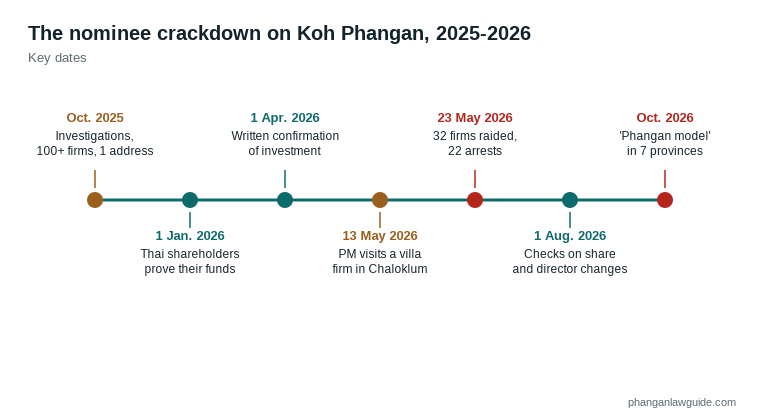
| Date | What happened |
|---|---|
| Oct. 2025 | Investigations open on Koh Samui and Koh Phangan; checks on resident foreigners' travel and visas |
| Oct. 2025 | More than 100 companies found registered at a single address on Koh Phangan |
| 1 Jan. 2026 | DBD Order No. 2/2568: Thai shareholders must prove where their money came from; the DBD later reports a drop of more than 65% in suspicious registration attempts |
| 1 Apr. 2026 | DBD Order No. 1/2569: written confirmation that all shareholders genuinely invested |
| 8 May 2026 | The DBD counts 11,426 companies with foreign capital on the two islands, about 68% of all companies |
| 13 May 2026 | The Prime Minister visits a villa company in Chaloklum and orders a financial investigation |
| 23 May 2026 | "Phase 2": 32 companies raided, 22 foreigners arrested, land seized |
| 1 Aug. 2026 | DBD Order No. 2/2569: checks extend to changes of shareholders and directors |
| Oct. 2026 | The "Phangan model" is extended to seven provinces, with more than 110 arrests announced |
According to provincial data reported by the Thai press, Surat Thani province has about 11,600 companies with foreign shareholders, including about 3,200 on Koh Phangan and 8,200 on Koh Samui. The authorities stress that these figures do not prove wrongdoing: they explain why the area is classed as high-risk.
How do investigators spot a nominee?
Several agencies work together:
- DBD (Ministry of Commerce): screens high-risk companies and their shareholders.
- DSI (Department of Special Investigation): handles major cases.
- Land Department: checks property histories and can order the sale of illegally held land.
- AMLO (Anti-Money Laundering Office): wants powers to freeze and seize assets linked to nominees.
- Revenue Department: compares Thai shareholders' income with the value of their shares.
Since 2026 the state has also used automated screening of tens of thousands of company and land records. The red flags are therefore well known. Take the test:
What penalties do you face?
| Law | Who | Penalty |
|---|---|---|
| Foreign Business Act, s.36 | The Thai nominee | Up to 3 years in prison and/or a 100,000–1,000,000 THB fine, plus 10,000–50,000 THB per day if a court order is ignored |
| Foreign Business Act, s.37 | The foreigner running a restricted business through a nominee | Up to 3 years and/or 100,000–1,000,000 THB, and an order to stop or dissolve the business |
| Foreign Business Act, s.41 | Directors who allowed it | The same penalties |
| Land Code, s.94 | Illegally acquired land | Order to sell within 180 days to one year; auction if not sold |
| Immigration law | The foreigner | Visa cancellation, deportation and a possible re-entry ban after a conviction |
If the anti-money-laundering route is used, assets can be frozen and then confiscated, which is far heavier than a forced sale.
What does the DBD check when a company registers or changes?
When a company has foreign shareholders below 50%, or a foreign director with signing power, each Thai shareholder must provide:
- three months of bank statements showing the money really belonged to them;
- an "investment explanation letter" showing how the money reached the company;
- a declaration of genuine investment, signed by the director filing the application.
An account with no regular activity, or money that comes in and goes out the same day, can block the filing. Since 1 August 2026 these checks also apply when a shareholder or director changes, for example when a foreigner becomes a signing director.
You own a villa or a business through a Thai company: what should you do?
Don't panic, but don't improvise either. The most dangerous thing is to react in a rush.
- Gather your documents: articles of association, shareholder list, share certificates, side agreements or loans, land title and lease, bank transfers.
- Look at the facts honestly: did each Thai shareholder really pay for their shares with their own money? Do they take part in the company?
- Do not create or backdate documents, and do not move assets in a hurry: an administrative problem can then become a criminal one.
- Get advice from an independent Thai lawyer who did not set up the structure.
- Look at the legal options: a registered 30-year lease or superficies right in your own name, a Foreign Business Licence, BOI promotion, the Treaty of Amity for Americans, bringing in genuine Thai partners, scaling the business down to what foreigners may do, or a proper sale.
- Check your rentals: above 8 rooms or 30 guests, short-term rental requires a hotel licence.
Buying now: how do you avoid the trap?
- Ask who really owns the land and the company before paying anything.
- Be wary of any offer to "buy the company" instead of registering a lease or a sale at the Land Office.
- Ask for proof of investment from the Thai shareholders if a company is involved.
- Prefer a registered 30-year lease in your own name, and value it as 30 years.
FAQ
Is every Thai company with a foreign shareholder illegal?
No. A company whose Thai investors really paid for their shares and take part in decisions and profits is legal. The offence is using Thai nationals as mere names.
What happens to a villa held through a nominee company?
The Land Department can order the land to be sold within 180 days to one year, with an auction if it is not sold. If anti-money-laundering rules are applied, assets can be frozen and then confiscated.
Can a foreigner be deported in a nominee case?
Yes. A conviction can lead to visa cancellation, deportation and a ban on returning to Thailand, on top of the fine or prison sentence.
Is the crackdown only on Koh Phangan?
No. It started on Koh Phangan and Koh Samui, then was extended in October 2026 to seven provinces, with cases reported in Phuket, Krabi and Pattaya.
I bought a villa through a company years ago. Do I have to sell?
Not necessarily. First have an independent Thai lawyer check whether the structure is genuine. Many owners can restructure, for example by holding the house and a registered lease in their own name.
Sources
- DSI — nominee crackdown on Koh Samui and Koh Phangan
- The Nation — the legal loopholes exposed by the crackdown
- Thairath — DBD figures for Samui and Phangan, May 2026
- Thairath — phase 2 on Koh Phangan, May 2026
- Thairath — DBD Order No. 2/2569 and checks from 1 August 2026
- Khaosod English — over 100 companies at a single address
- Chambers — DBD Orders 2/2568 and 1/2569
- Luther — Thailand tightens rules on foreign shareholding
- Rajah & Tann — DBD Order No. 2/2569
- Thai government — nominee prohibition
- Lex Bangkok — Foreign Business Act penalties
- The Star — the "Phangan model" goes national
Share
Related guides
 BusinessRenting your villa to tourists: licence or not?Short-term rentals on Koh Phangan: the 8-room, 30-guest threshold, non-hotel notification, hotel licence, condos,…
 BusinessWork permit: who needs one?Thailand work permit: 2M THB capital and 4 Thai staff, Non-B visa, e-Work Permit, DTV and remote work, reserved…
 BusinessExpat tax: the 180-day ruleThai tax residence at 180 days, foreign income taxed when brought in since 2024, pre-2024 savings, the 0–35% scale…Property30+30+30 leases after 4655/2566Is a 30+30+30 lease still valid? What Supreme Court ruling 4655/2566 means for Koh Phangan villas, options for…