Non-Immigrant O visa: the visa for retirees and families, explained

On this page4
Non-O, O-A, O-X, extension: retirees arriving on Koh Phangan quickly get lost. Yet it all starts with one letter: the "O".
What is the Non-O visa?
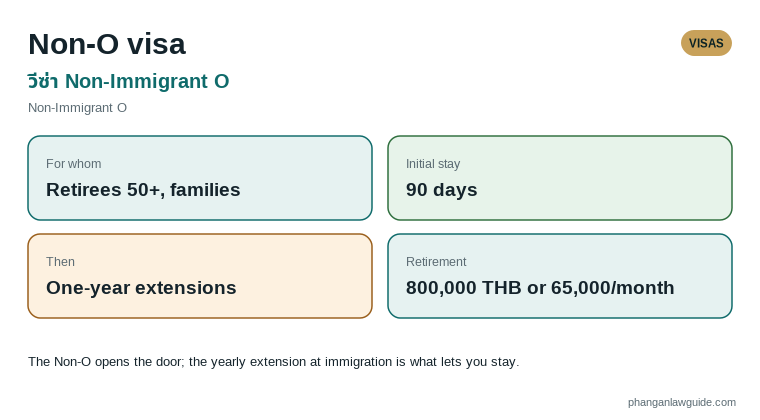
The Non-Immigrant O is a visa category for stays that are neither tourism nor work: retirement from age 50, marriage to a Thai national, parent of a Thai child, accompanying family.
It is obtained at an embassy or, in some cases, by change of status in Thailand. It gives a 90-day stay, during which you apply at immigration for a one-year extension on the chosen ground, renewed each year with the financial evidence.
Why does it matter on Koh Phangan?
It is the route most used by retirees settled on the island. Extensions are applied for at the competent immigration office, with the financial file, the TM30 and up-to-date 90-day reports.
Frequently asked questions
What does Non-O mean?
Non-Immigrant O, a visa category for "other" stays: retirement, marriage, family.
How long does a Non-O visa last?
It gives a 90-day stay, then you apply at immigration for a renewable one-year extension.
What is the difference between Non-O, O-A and O-X?
The Non-O is followed by yearly extensions in Thailand; the O-A and O-X are long-stay retirement visas applied for from abroad, with their own conditions.
Sources
- Thai Law Online: 2026 retirement visa, O-A, O-X and 800,000 THB
- Issa Compass: Thailand retirement visa 2026
Share
Related guides
 GlossaryRe-entry permit: definitionThe re-entry permit protects your extension of stay when you leave Thailand: 1,000 THB single, 3,800 THB multiple,…
 GlossaryTabien Baan: definitionThe Tabien Baan is the house registration of a home in Thailand: blue book for Thais, yellow book (Tor Ror 13) for…
 GlossaryPor Ror Bor: definitionPor Ror Bor, Thailand's compulsory vehicle insurance: 30,000 THB of care before fault, up to 80,000 and 500,000 THB…VisasRetirement visa: Non-O, O-A or O-X?Thailand retirement visa from 50: 800,000 THB or 65,000 THB a month, the deposit calendar, insurance, the 10-year…