DTV visa to live on Koh Phangan: requirements, the August 2026 changes and the traps

On this page8
Lea designs for agencies in Paris. She planned to spend the winter in Srithanu, apply for her DTV from Penang like a friend did in 2025, and be back on the island ten days later. Since 31 August 2026 that plan no longer works: the embassy has to be the one for her own country, and she needs a criminal record certificate.
The DTV is still the best visa for living several months on Koh Phangan while working for clients abroad. But the rules have changed, and so have the checks on the island. Here is what you need to know to get it, keep it and not lose it.
Who is the DTV visa for?
The DTV was launched in July 2024. It targets three profiles:
- Remote workers and freelancers ("workcation"): employees of a foreign company, freelancers, digital nomads, whose clients or employer are outside Thailand.
- People joining "soft power" activities: Muay Thai, Thai cooking classes, medical treatment and other recognised activities, with an enrolment letter from the provider.
- Their family: a spouse and children under 20 can apply as dependants, each paying the fee.
The minimum age is 20. Be careful with Thai language schools: law firms report they no longer appear among accepted examples and that such applications are being refused.
What changed on 31 August 2026?
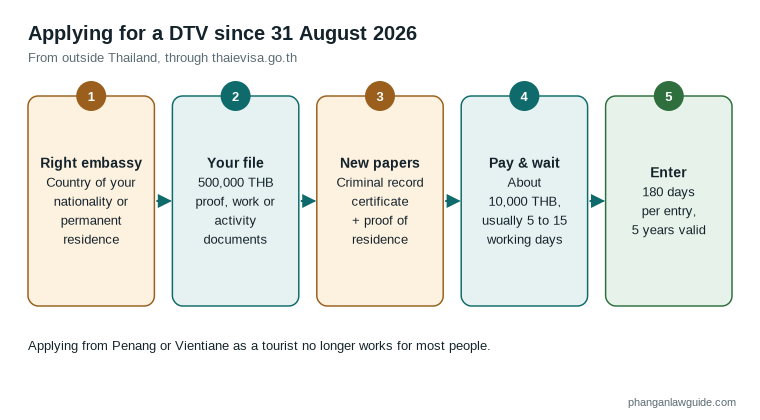
For applications filed through the e-Visa system from 31 August 2026 (midnight, Thai time), two documents changed:
- Proof of permanent residence replaces the document that simply showed where you were when applying.
- A criminal record clearance certificate is now required.
In practice you must apply through the embassy or consulate covering your country of nationality or permanent residence. The "DTV run" to Penang, Vientiane or Kuala Lumpur as a tourist therefore no longer works for most people. Embassies do not all accept the same proof of residence: check the list of the one that will receive your file. Applications filed before 31 August are still processed under the old rules.
How long can you stay on a DTV?
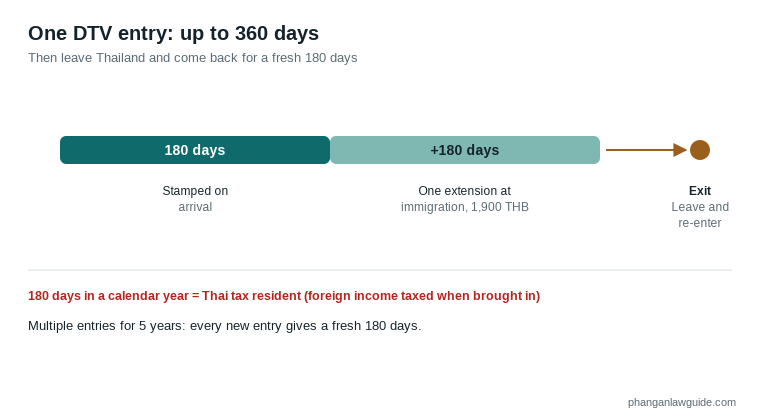
- Visa validity: 5 years, multiple entries.
- Stay per entry: 180 days, stamped on arrival.
- Extension: once per entry, by 180 days, at an immigration office (form TM.7, 1,900 THB). It is a request, not a right: some offices ask for recent bank statements, proof that you still work remotely and your rental contract.
- After that: after 360 days at most, you must leave Thailand. Each new entry gives you another 180 days.
The usual obligations apply on the island: the TM30 address report by your landlord and the 90-day report if you stay more than 90 days in a row.
What does the DTV not allow?
The DTV lets you work from Thailand, not for Thailand. Working for a Thai company or client, or working on the island (yoga classes at a local studio, diving, construction, a restaurant) requires a work visa and a work permit. The DTV cannot be used to get a work permit.
The checks are real. In August 2026, six foreign dive instructors were arrested on Koh Tao, the neighbouring island that belongs to Koh Phangan district: according to the Thai press, all of them held a DTV and were working for local dive shops without permits. On Koh Phangan, joint operations by police, immigration and the labour ministry multiplied in 2025 and 2026.
Does the DTV make you a Thai tax resident?
Not the visa itself, but your days in the country. 180 days or more in Thailand in a calendar year make you a Thai tax resident for that year. Your foreign income for that year then becomes taxable in Thailand if you bring it into the country, in that year or later. Income earned before 2024 is exempt. With a single extended entry, you easily pass 180 days: talk to a tax adviser and check the tax treaty between Thailand and your country.
Tax residence simulator
180 days in Thailand in a calendar year, and the money you bring in.
Indicative simulation only, not a substitute for advice from a licensed lawyer or accountant.
What should you do this week?
FAQ
Can you apply for a DTV from inside Thailand?
No. The DTV is only issued outside Thailand, and a tourist stay cannot be converted into a DTV locally. Since 31 August 2026, you must apply through the mission covering your country of nationality or permanent residence.
How much does the DTV cost?
The visa fee is about 10,000 THB, paid in the embassy's local currency (for example £300 in London or USD 400 in Washington). It is not refunded if you are refused. The 180-day extension costs 1,900 THB at immigration.
Do you have to keep 500,000 THB in your account at all times?
You must show it when you apply, often on three months of statements, and keep it until the decision. Some immigration offices ask for recent statements again when you extend.
Can you work for Thai clients on a DTV?
No. The DTV covers remote work for foreign employers and clients. Working for a Thai business or client requires a work visa and a work permit.
Where do you extend a DTV when living on Koh Phangan?
At the Koh Phangan immigration office in Thong Sala, or at the Koh Samui office in Mae Nam. Go before your 180 days run out, with your passport, form TM.7, a photo, copies and 1,900 THB in cash.
Sources
- Royal Thai Embassy, Moscow — DTV document changes from 31 August 2026
- Royal Thai Consulate, Los Angeles — official DTV page
- Lex Bangkok — DTV: new rules from 31 August 2026
- Thai Law Online — DTV requirements, extension and tax
- The Thaiger — Thailand DTV visa 2026: requirements, cost and how to apply
- Daily News — DTV holders arrested as dive instructors on Koh Tao
- Dive Magazine — foreign dive instructors arrested on Koh Tao
Share
Related guides
 VisasOpening a Thai bank accountSince 2025, Thai banks turn away most tourists and DTV holders. Which visa lets you open an account, what to bring,…
 VisasRetirement visa: Non-O, O-A or O-X?Thailand retirement visa from 50: 800,000 THB or 65,000 THB a month, the deposit calendar, insurance, the 10-year…
 VisasThailand Privilege visa (Elite)From 650,000 to 5 million baht, 5 to 20 years: what the Thailand Privilege visa allows, what it doesn't (working),…
 BusinessWork permit: who needs one?Thailand work permit: 2M THB capital and 4 Thai staff, Non-B visa, e-Work Permit, DTV and remote work, reserved…