TM30 and the 90-day report on Koh Phangan: who reports what, and when
On this page5
Claire rented a house in Haad Yao for a year on a retirement visa. On the day of her extension, the immigration officer asked for the TM30 receipt. Her landlord had never filed one. Application refused, back the next week after several calls to the landlord.
The TM30 and the 90-day report are the two formalities that trip up the most foreigners in Thailand. They are simple, free when done on time, and almost always checked at the moment you need immigration.
What is the TM30, and who must file it?
The TM30 comes from section 38 of the 1979 Immigration Act. The owner, possessor of the dwelling or hotel manager housing a foreigner must report them to immigration within 24 hours. The duty falls on the host, not on you:
- a fine of up to 2,000 THB for a private owner;
- 2,000 to 10,000 THB for a hotel or rental residence.
In practice you are the one who suffers: immigration often asks for the TM30 receipt for a visa extension, a work permit or a 90-day report. If you own your condo, you file your own TM30, and your foreign tenants' too.
Hotels, resorts and rental managers normally file it automatically. For a house rented from a private owner, ask for it when you sign the lease.
How does the 90-day report work?
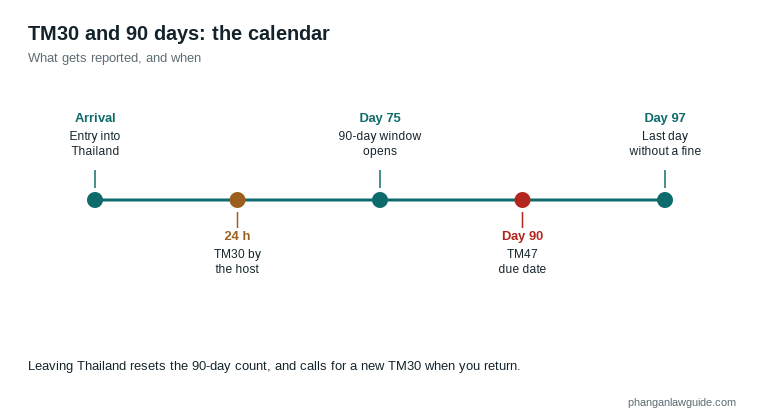
Every foreigner staying more than 90 days in a row in Thailand must report their address on form TM47. That covers retirement, marriage, DTV, Non-B, education visas and most long stays. The report is not a visa extension: it is just an address notification.
- Window: from 15 days before to 7 days after the due date.
- First report: in person at the immigration office, or by someone holding a power of attorney.
- Later reports: online on the official portal tm47.immigration.go.th, approved within one to three days, or by registered post.
- More than 7 days late: in person only, with a 2,000 THB fine; up to 5,000 THB if the breach is found during a check.
Every exit from Thailand resets the count: it starts again from your new entry.
90-day report calendar
Enter your last entry into Thailand or your last report.
Indicative simulation only, not a substitute for advice from a licensed lawyer or accountant.
What about travel or moving house?
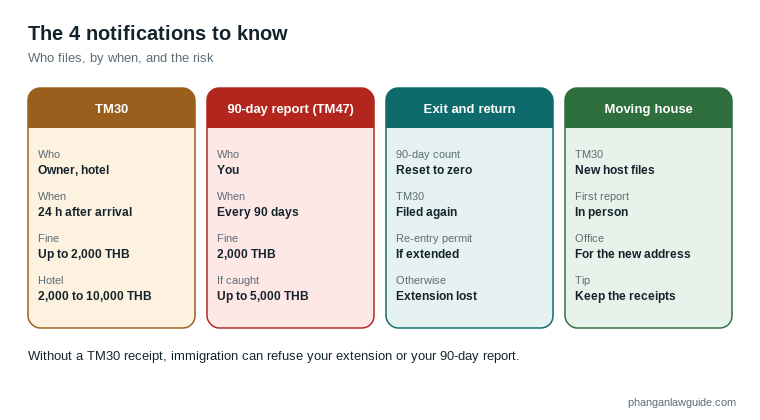
- Travel abroad: when you return, your host must file a new TM30, and your 90-day count restarts. If you hold an extension of stay (retirement, marriage, work), get a re-entry permit before leaving, or the extension is lost.
- Moving house: the new host files a TM30, and the first report at the new address is made in person at the competent office.
- Travel to another province: the law also provides for notifications of stays over 24 hours elsewhere (form TM28 for the foreigner), rarely required in practice. If in doubt, ask the immigration office.
Keep every receipt (TM30, TM47) as a photo on your phone: they are what you will be asked for.
Frequently asked questions
Who must file the TM30?
The owner, possessor of the dwelling or hotel manager, within 24 hours of the foreigner's arrival. If you own your home, you file it yourself.
What is the fine for not filing a TM30?
Up to 2,000 THB for a private owner, and 2,000 to 10,000 THB for a hotel. The foreigner mainly risks a refused extension or report.
Can you do the 90-day report online?
Yes, from the second report, on immigration's official portal. The first is done in person, or by someone holding a power of attorney.
When is the 90-day report due?
Between 15 days before and 7 days after the due date shown on your last receipt.
What happens if you miss the 90-day report?
You pay 2,000 THB by coming forward at immigration, and up to 5,000 THB if the breach is found during a check.
Does the 90-day count restart after a trip?
Yes. Every exit from Thailand resets the count, and your host must file a new TM30 when you return.
Sources
- ThaiLawOnline: TM30 and section 38 of the Immigration Act
- Forvis Mazars: form TM30 and the 2,000 THB fine
- Deloitte: TM30 duties of owners and hotels
- The Thaiger: when and how to file the TM47
- ThaiLawOnline: 2026 guide to the 90-day report
- BAL: TM30 receipt required for extensions and reports
Share
Related guides
 VisasDTV visa: the 2026 rulesDTV visa: 500,000 THB, 180 days per entry, criminal record required since 31 Aug. 2026. Who qualifies, what it…VisasOverstaying your visa500 baht a day, capped at 20,000, a 1 to 10-year ban beyond 90 days, 5 years if you're caught: the Thailand overstay…
 VisasRetirement visa: Non-O, O-A or O-X?Thailand retirement visa from 50: 800,000 THB or 65,000 THB a month, the deposit calendar, insurance, the 10-year…GlossaryTabien Baan: definitionThe Tabien Baan is the house registration of a home in Thailand: blue book for Thais, yellow book (Tor Ror 13) for…