Is a 30+30+30 lease still valid in Thailand? Supreme Court ruling 4655/2566 explained

On this page8
On Koh Phangan listings, the same promise keeps coming back: "30 + 30 + 30 lease, so 90 years". Many buyers prepaid those 90 years, convinced they were protected for three generations. A Thai Supreme Court decision changed the picture: only the first 30 years really hold.
Here is what it says, what is still valid, how to tell whether your lease is fragile and what you can do right now.
What is a "30+30+30" lease?
Foreigners cannot own land in Thailand, so most Koh Phangan villas are sold as leasehold: a registered lease on the land, with the house often held separately. The Civil and Commercial Code caps a land lease at 30 years (section 540). Sellers therefore long offered "30 + 30 + 30": a first 30-year lease and, signed the same day, a promise to renew it twice.
What did the Supreme Court decide in ruling 4655/2566?
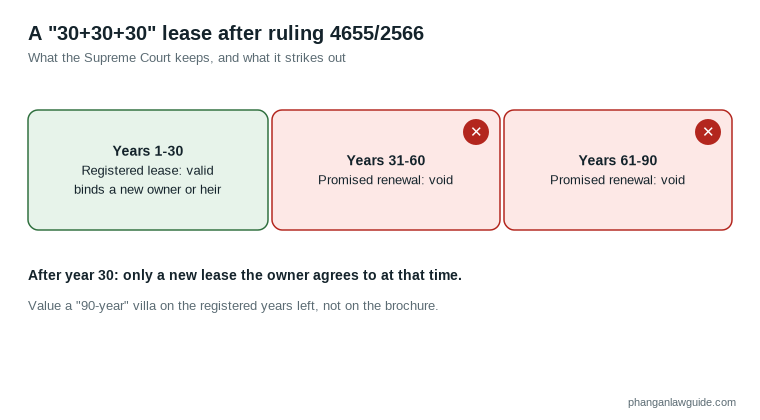
The case concerned a Phuket lease signed in 1990 for 30 years, with a same-day promise of two 30-year renewals. The tenant had prepaid all 90 years. When the first term ended in 2020, the owner asked him to leave and went to court. The Supreme Court held that:
- the first registered 30-year lease was valid;
- the renewal promises were void, because they were used to get around the 30-year cap in section 540;
- the tenant could not enforce the promise as an ordinary contract either, as that would defeat the purpose of the law.
His occupation after 2020 was therefore unlawful, the prepayment did not protect him, and the owner was awarded damages for the extra period.
About the date: the decision dates from 2023 (Thai year 2566). It became widely known when law firms published their analyses in March 2025, which is why many articles call it a "2025 ruling". Older decisions already treated renewal options as personal promises with no effect on a new owner, so the risk is not new.
What is still valid, and what is not?
| Item | Position after ruling 4655/2566 |
|---|---|
| First lease of up to 30 years, registered at the Land Office | Valid; binds a buyer or heir of the land |
| Lease over 3 years that is not registered | Enforceable for 3 years only |
| Renewals agreed and paid at the start, on the same terms | Void |
| A genuine new lease signed when the first one ends | Possible, if the owner agrees at that time |
| A second lease registered in advance by the Land Office | Registration is not enough: a court may find it was meant to exceed 30 years |
| Superficies (owning the house on someone else's land) and usufruct | Separate rights, registered at the Land Office, useful alongside a lease |
Thai Supreme Court decisions are highly persuasive but do not bind judges as precedent, and lawyers still debate their scope, for example for an option that requires a genuine new agreement and a new rent when it falls due. On the core point, the message is the same everywhere: only the first 30 years are safe.
Why does this matter so much on Koh Phangan?
- Almost all foreign-held villas on the island are leasehold, and many listings still advertise "30 + 30" or "90 years".
- Many villas sit on land owned by local families: when the owner dies, the land passes to heirs who promised nothing.
- The nominee crackdown has closed the "company" route for many buyers.
- Resale value depends on the remaining term: a villa with 18 years left is worth far less than the brochure suggests.
I already have a 30+30+30 lease: what should I do?
- Reread your documents: dates of the lease and the promise, what was registered at the Land Office, whether rent is revised on renewal.
- Identify the current landowner and check whether the land has been sold or inherited since signing.
- Value your villa on the remaining registered term, not the brochure term.
- Talk to the owner early, while the relationship is good: a renewal negotiated near expiry, at a fair rent, is still the safest route.
- Add complementary rights: superficies for the house, a lifetime usufruct over the land, or the new registrable rights over leased property, which can be transferred, mortgaged and inherited.
- Money prepaid for renewals can sometimes be claimed back, but time limits are short and everything depends on the owner's ability to pay: get advice quickly.
Don't rely on proposed 99-year leases: they are only proposals, not law.
Buying a leasehold villa: what should you check before paying?
- Get a copy of the land title and check it at the Koh Phangan Land Office: owner, title type (Chanote or Nor Sor 3 Gor), mortgages, existing leases.
- Check that the lease is registered and runs for 30 years from today, not from an earlier date.
- Register a superficies right in your name for the house.
- Treat any "renewal" clause as a bonus with no guaranteed value.
- Check the building permit and the house's compliance.
- Pay in stages, never a large deposit before these checks.
FAQ
Is my 30-year lease still valid after ruling 4655/2566?
Yes. The first lease of up to 30 years, properly registered at the Land Office, remains valid and binds a new owner or the heirs of the land.
Can a lease still be renewed after 30 years?
Yes, but only if the owner agrees at that time and signs a new lease. An automatic renewal promised at the start cannot be enforced.
Does the Land Office registering a second lease protect me?
Not fully. Registration is an administrative step; a court can still decide the arrangement was meant from the start to exceed 30 years.
Can I get back money I prepaid for renewals?
Possibly, as unjust enrichment, but time limits are short and everything depends on the owner's ability to pay. See a lawyer quickly.
Are 99-year leases now allowed in Thailand?
No. Longer leases have been discussed, but as of November 2026 they are only proposals. Ordinary residential leases remain capped at 30 years.
Sources
- Lex Bangkok — the 30-year lease renewal trap
- Mondaq — Supreme Court strikes down automatic renewals
- Addleshaw Goddard — briefing of 10 March 2025
- Siam Legal — ruling on long-term leases
- Chambers — Real Estate 2026, Thailand
- Samui For Sale — the real story behind the ruling
Share
Related guides
 PropertyBuying a condo: the 49% quotaA foreigner can own a Thai condo freehold: the 49% quota, the foreign-currency transfer and FET form, the 2% fee,…
 PropertyChanote vs Nor Sor 3 Gor: which land title?Chanote, Nor Sor 3 Gor, Nor Sor 3, Sor Kor 1, Por Bor Tor 5: what each Thai land document is worth on Koh Phangan,…PropertyCheck a property before you buyFree tool: check the title, seller, access, forest, structure and payment before you buy or lease on Koh Phangan.…
 BusinessNominee crackdown 2025–2026Why Thailand is raiding nominee companies on Koh Phangan: figures, penalties, how investigators work and what villa…