Work permit in Thailand: who needs one on Koh Phangan, and how to get it

On this page7
On 1 May 2026, soldiers, police and immigration officers walked into a childcare centre on Koh Phangan. Several foreign teachers were working there without permits. They admitted the charges and were sent to the Koh Samui court. Days later, the Labour Minister ordered checks nationwide, naming the island.
Yoga teacher, wellness practitioner, villa manager, electrician, bartender: on the island, many foreigners work without realising they are breaking the law. By late August 2026, the province had issued 2,513 work permits on Koh Phangan, far fewer than the number of foreigners actually working there.
What counts as "work"?
Thai law (the 2017 Emergency Decree on the Management of Foreigners' Working, amended in 2018) defines work very broadly: any physical or intellectual effort, paid or not. Volunteering counts, as do classes given to friends for a contribution, or helping out in a relative's café.
The permit only covers the job and the employer written on it. A yoga teacher who also gives massages, or a manager who also does the electrical work, steps outside the permit and can be prosecuted.
Who may work, and for whom?
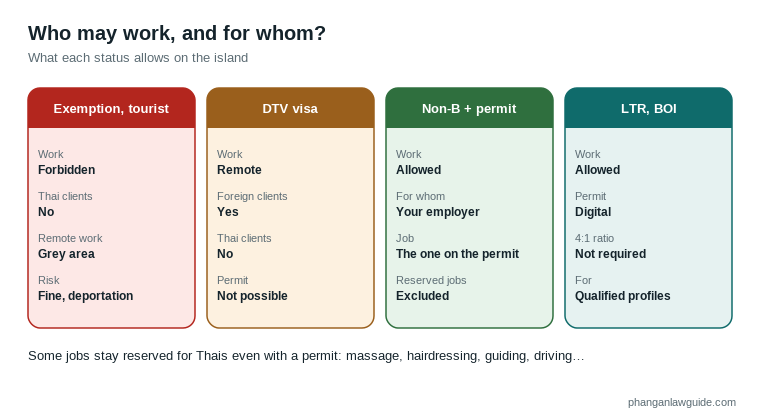
- Visa exemption or tourist visa: no work in Thailand.
- DTV: allows remote work for an employer or clients outside Thailand. It allows neither invoicing Thai clients nor working for a Thai company, and no permit can be issued on this visa.
- Non-B visa with a work permit: the standard route for a local job.
- LTR (qualified long-term residents) and BOI companies: digital permit, no Thai staff ratio.
Marriage to a Thai national lowers the bar: 1 million THB of capital and 2 Thai employees instead of 2 million and 4.
How do you get a work permit?
- A company that qualifies. For a standard Thai company: 2 million THB of paid-up capital and 4 Thai employees registered for social security per foreigner.
- The right visa. A Non-B visa, from a Thai embassy or by conversion in Thailand depending on your situation.
- The online application. Since October 2025 everything goes through the Department of Employment's e-Work Permit system. The employer files and verifies its identity with the ThaiID app.
- The digital permit. The blue book is gone, replaced by a QR-code digital card. Since July 2026, a temporary permit can be issued on approval.
- The extension of stay. With the permit, immigration grants a one-year extension, renewed each year with the permit.
Government fees are modest, 3,000 THB for one year and 6,000 THB for two. The real cost is the structure: capital, Thai salaries, accounting and monthly filings.
Which jobs are closed to foreigners?
Even with a permit, some jobs stay reserved for Thais. The list includes traditional Thai massage, hairdressing and beauty services, street vending, driving vehicles, tour guiding and security work. Others, such as construction and masonry, are open only under conditions.
On Koh Phangan, the Tourist Police arrested two foreigners in November 2025 who were running construction and electrical work themselves, and, in an earlier wave of checks, a Briton teaching tantra yoga on a permit for a different job.
What do you risk without a permit?
- The worker: a fine of 5,000 to 50,000 THB, deportation, and a 2-year ban on applying for a permit.
- The employer: 10,000 to 100,000 THB per worker; for repeat offences, up to one year in prison, up to 200,000 THB per worker and a 3-year ban on hiring foreigners.
- Failing to show your permit at a check: up to 5,000 THB.
Checks have multiplied on the island: 25 sites raided and 35 people or companies charged in January 2026, then the childcare centre in May and the second wave against nominee companies the same month.
Which visa is right for me?
5 questions, an instant recommendation.
Indicative simulation only, not a substitute for advice from a licensed lawyer or accountant.
Frequently asked questions
Do you need a work permit to volunteer in Thailand?
Yes. The law covers any physical or intellectual effort, paid or not: volunteering counts as work.
Can you work on a DTV visa?
Yes, but only remotely, for an employer or clients outside Thailand. Invoicing Thai clients or working for a Thai company is still forbidden, and no permit can be issued on a DTV.
What are the requirements for a Thai work permit?
In the standard case: a Thai company with 2 million THB of paid-up capital and 4 Thai employees per foreigner, a Non-B visa and an online application on the e-Work Permit system. The requirements are halved if you are married to a Thai national.
How much does a Thai work permit cost?
Government fees are 3,000 THB for one year and 6,000 THB for two. The real cost lies in the company, salaries and accounting.
What is the fine for working without a permit?
5,000 to 50,000 THB for the worker, with deportation and a two-year ban on permits. The employer faces 10,000 to 100,000 THB per worker.
Which jobs can foreigners not do in Thailand?
Among others, Thai massage, hairdressing, street vending, driving, tour guiding and security work, even with a permit.
Sources
- Nation Thailand: Labour Minister orders checks after the Koh Phangan raid (May 2026)
- Nation Thailand: illegal school raid on Koh Phangan
- Khaosod English: 25 sites raided on Koh Phangan (January 2026)
- Nation Thailand: penalties for workers and employers
- Khaosod English: 2,513 work permits issued on Koh Phangan
- ThaiLawOnline: Thai work permit, fees and exceptions
- The Thaiger: the DTV does not allow invoicing Thai clients
- Pattaya Mail: crackdown on illegal foreign businesses on Koh Phangan
- The Independent SG: two foreigners charged over unpermitted work on Koh Phangan
- EY: launch of the e-WorkPermit platform
Share
Related guides
 BusinessNominee crackdown 2025–2026Why Thailand is raiding nominee companies on Koh Phangan: figures, penalties, how investigators work and what villa…
 BusinessExpat tax: the 180-day ruleThai tax residence at 180 days, foreign income taxed when brought in since 2024, pre-2024 savings, the 0–35% scale…
 BusinessRenting your villa to tourists: licence or not?Short-term rentals on Koh Phangan: the 8-room, 30-guest threshold, non-hotel notification, hotel licence, condos,…
 VisasDTV visa: the 2026 rulesDTV visa: 500,000 THB, 180 days per entry, criminal record required since 31 Aug. 2026. Who qualifies, what it…