Buying property on Koh Phangan as a foreigner: land, leases and titles

On this page8
On Koh Phangan, the sea view is easy to find. Clean paperwork is not. Most problems buyers face here were visible in the documents before they paid: the wrong title type, a lease that was never registered, a "company" that was really a nominee.
Can a foreigner own land on Koh Phangan?
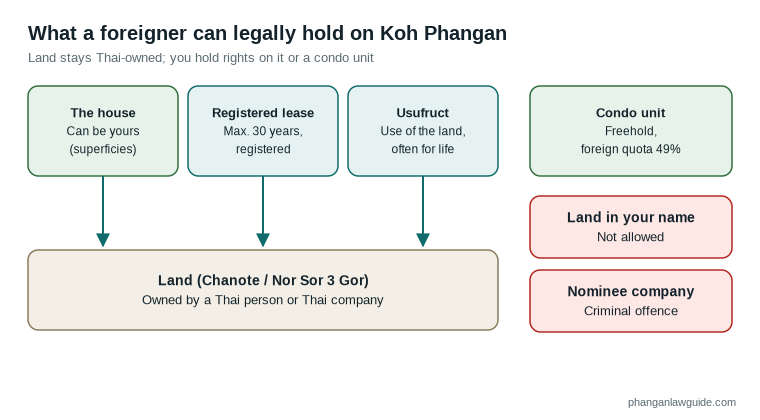
No. Under the Thai Land Code, land ownership is reserved for Thai nationals and Thai-majority entities, with very narrow exceptions (such as a large BOI-approved investment). This applies everywhere in Thailand, including the islands.
What a foreigner can legally hold:
| Option | What you get | Main limit |
|---|---|---|
| Registered lease | Right to use the land, up to 30 years | Renewal promises are not guaranteed |
| Building ownership | The house itself, in your name | Land still belongs to someone else |
| Superficies | Right to own structures on someone else's land | Must be registered at the Land Office |
| Usufruct | Right to use and earn from the land, often for life | Ends at death; cannot be inherited |
| Condominium unit | Freehold ownership of a unit | Foreign quota (49% of the building's total floor area) |
How do 30-year leases really work?
The Civil and Commercial Code caps a lease of immovable property at 30 years. A lease longer than 3 years must be registered at the Land Office; if it is not, it is only enforceable for 3 years.
Many Koh Phangan villas are still marketed as "30 + 30 + 30". In Supreme Court decision 4655/2566 (decided in 2023, widely reported from March 2025), the court held that renewal clauses agreed in advance to stretch a lease beyond 30 years are void, even when the full rent was prepaid. The first registered 30-year term remains valid. After it ends, a new lease can be signed, but only if the owner (or their heirs) agrees at that time. Price a leasehold villa as a 30-year asset, not a 90-year one.
At registration, expect a fee of about 1% of the total rent over the lease term, plus stamp duty of 0.1%.
What does a purchase cost in fees?
| Cost | Rate | Usually paid by |
|---|---|---|
| Transfer fee | 2% of the Land Office appraised value | Often split 50/50 (negotiable) |
| Specific business tax | 3.3% if the seller owned the property for less than 5 years | Seller |
| Stamp duty | 0.5% (only when specific business tax does not apply) | Seller |
| Withholding tax | Depends on the seller (individual or company) | Seller |
A temporary reduced transfer fee applies to some Thai buyers only: foreign buyers pay the full 2%. Write who pays what into the contract.
Which land titles exist on Koh Phangan?
Older title types are common on the island. The type of title changes what you can safely do.
| Title | What it is | What to watch |
|---|---|---|
| Chanote (Nor Sor 4 Jor) | Full ownership title, surveyed and mapped | The most secure; still check encumbrances |
| Nor Sor 3 Gor | Confirmed right of use, with defined boundaries | Can be sold, leased and mortgaged |
| Nor Sor 3 | Right of use, boundaries less precise | Transfers involve a public notice period; boundaries can be disputed |
| Sor Kor 1 and similar | Claim of possession only | Not a title: avoid for any serious investment |
Why avoid nominee companies?
For years, some buyers held land through a Thai company where the Thai shareholders were only "names". This is illegal and can lead to criminal penalties and loss of the land. Since late 2025, Koh Phangan has been the starting point of a national crackdown on nominee structures: raids on villa companies, arrests and land seizures in 2026, and stricter company registration rules since 1 August 2026. A company is only safe if its Thai shareholders are genuine investors and the company has a real business purpose. See Business & companies.
What building rules apply on the island?
Koh Phangan is part of an environmentally protected area. This affects what can be built where, including on hillsides and near the coast. Before buying, check that the building has a building permit matching what was actually built, and that the plot's zoning allows your plans.
What should you check before paying a deposit?
- Get a copy of the title deed and check it at the Koh Phangan Land Office (owner, title type, area, mortgages, existing leases).
- Confirm the person signing is the owner, or holds a valid power of attorney.
- Check access to the plot: a registered road or servitude, not just a track over a neighbour's land.
- Check the building permit and that the house matches it.
- Read the lease or sale contract in a language you understand, with a Thai version that matches.
- Never pay a large deposit before these checks are done.
FAQ
Can I buy land if I marry a Thai national?
Your Thai spouse can buy land in their own name. The foreign spouse usually has to sign a declaration that the money used is the Thai spouse's own property. The land belongs to the Thai spouse.
Is a 30-year lease automatically renewed?
No. Since Supreme Court decision 4655/2566, renewal clauses agreed in advance to go beyond 30 years are void. Only the first registered 30-year term is protected.
Can a foreigner own a house on Koh Phangan?
Yes, a foreigner can own the building itself, separately from the land, typically combined with a registered lease or a superficies right over the land.
Are condos a simpler option?
Yes. A foreigner can own a condo unit outright, as long as total foreign ownership in the building stays within 49% of the floor area. There are fewer condos on Koh Phangan than on Samui or Phuket, though.
Share
Related guides
 PropertyBuilding your villa: permits and zonesA building permit (Or. 1) in your name, altitude zones, 35% slopes, a 6 m height cap: what a foreigner must know…
 PropertyBuying costs and taxes: who pays what?A 2% transfer fee, 3.3% business tax or 0.5% stamp duty, 1.1% to register a lease, yearly land tax: the real cost of…
 PropertyBuying a condo: the 49% quotaA foreigner can own a Thai condo freehold: the 49% quota, the foreign-currency transfer and FET form, the 2% fee,…
 PropertyChanote vs Nor Sor 3 Gor: which land title?Chanote, Nor Sor 3 Gor, Nor Sor 3, Sor Kor 1, Por Bor Tor 5: what each Thai land document is worth on Koh Phangan,…Property30+30+30 leases after 4655/2566Is a 30+30+30 lease still valid? What Supreme Court ruling 4655/2566 means for Koh Phangan villas, options for…
 PropertyRenting long term: your tenant rightsCapped deposit, refund within 7 days, electricity at the official rate, leaving early: the 2025 rules that protect…