Inheritance and wills in Thailand: protecting your family when you live on Koh Phangan

On this page8
Peter had lived in Srithanu for eight years with Noi, his Thai partner, without marrying. When he died, his Bangkok Bank account and his Thong Sala condo were frozen. With no will, Noi had no rights: the heirs were Peter's two children in Germany, who had to hire a Thai lawyer, have their birth certificates translated and legalised, and wait for the Koh Samui court's decision.
Nobody likes to think about it, but on the island the question comes up often: a scooter accident, a sudden illness. A few hours of preparation spare those you leave behind months of frozen assets and costs.
What happens to your Thai assets when you die?
Succession is governed by Book VI of the Thai Civil and Commercial Code. For immovable property in Thailand (condo, house, rights over land), Thai law applies whatever your nationality. For movable assets (accounts, car, shares), the law of your domicile applies in principle.
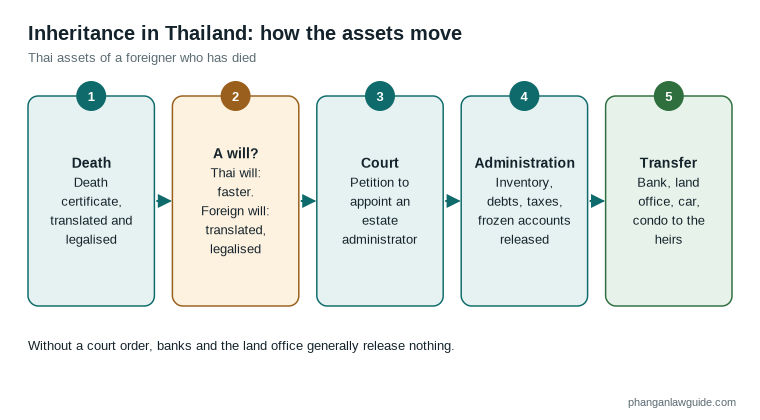
In practice, the bank, the land office or the transport office almost never hand over an asset on a death certificate alone. They require a court order appointing an estate administrator (sections 1711 onwards of the Code). It is the Thai equivalent of probate.
Who inherits if you have no will?
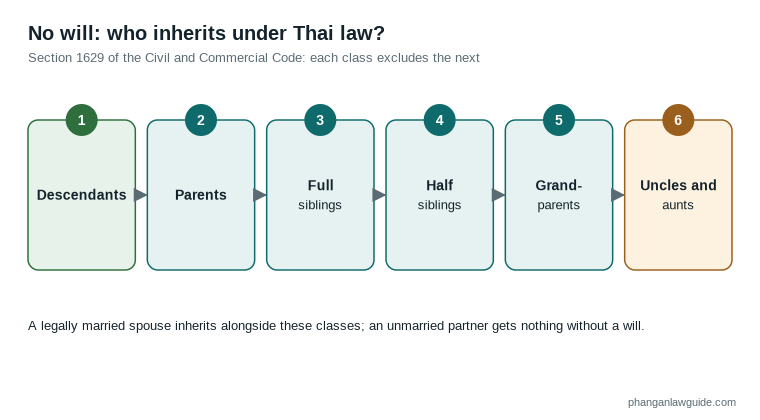
Section 1629 sets six classes of statutory heirs. Each class excludes the next: as long as there is a descendant, parents and siblings inherit nothing.
- Descendants (children, then grandchildren);
- parents;
- full siblings;
- half siblings;
- grandparents;
- uncles and aunts.
The surviving spouse inherits alongside these classes, but only if legally married (marriage registered in Thailand or recognised there). An unmarried partner, even after twenty years together, inherits nothing without a will. With no heirs at all, the estate goes to the State.
How do you make a valid Thai will?
The Code recognises five forms of will (sections 1655 to 1663). The two most used by foreigners:
- The ordinary written will: written, dated and signed by you, before two witnesses present at the same time, who also sign. Simple and inexpensive.
- The public will: declared before the district office (Amphoe) officer, who writes and records it. Stronger against challenges.
Rules to follow:
- be at least 15;
- a witness cannot inherit: if a witness, or their spouse, is a beneficiary, the gift to them is void;
- the will can be in a language other than Thai, but a Thai translation will be required in court;
- name a trusted executor, ideally someone in Thailand.
A ministerial regulation published on 22 January 2026, in force 60 days later, sets stricter procedures for wills and declarations recorded at district offices, and for disinheriting an heir or renouncing an inheritance. The Code's substantive rules do not change.
Is a foreign will enough?
It can be recognised in Thailand if it meets the formal requirements of the country where it was made. But it must then be translated, legalised and examined by the court, which often adds 6 to 12 months and costs. A Thai will limited to your Thai assets, coordinated with your will at home, is the fastest route for your heirs.
Can you inherit a condo, land or a lease?
- A condo: a foreign heir can inherit one; have a lawyer check the conditions for keeping it in their name (the building's foreign quota).
- Land: a foreigner cannot keep it. A foreign heir must generally sell it within a period set by the authorities, of up to one year.
- A lease: under case law, lease rights can end on the tenant's death if the contract does not provide for transfer to heirs. Check your lease, especially for a villa leased for 30 years.
- Shares in a Thai company: they form part of the estate, but the articles may restrict their transfer. And if the company is a nominee structure, the inheritance can expose it.
Is there inheritance tax in Thailand?
Yes, but only above 100 million THB received per heir: 10% on the part above that threshold, 5% for descendants and ascendants. A spouse is exempt. Most island estates do not reach this level. Do think about inheritance tax in your own country, which may apply to your Thai assets.
Frequently asked questions
Can a foreigner make a will in Thailand?
Yes. A foreigner can make a Thai will for assets in Thailand, in one of the five forms set by the Civil and Commercial Code, most often a written will signed before two witnesses.
Who inherits from a foreigner who dies in Thailand without a will?
For immovable property in Thailand, Thai law names six classes of statutory heirs, from descendants to uncles and aunts, plus a legally married spouse. An unmarried partner inherits nothing.
Do you need a Thai court for an inheritance?
Almost always. The court appoints an estate administrator, without whom banks and the land office generally refuse to release assets.
Is my foreign will valid in Thailand?
It can be recognised, but it must be translated, legalised and examined by the court, which often adds 6 to 12 months. A Thai will for your Thai assets is faster.
Can a foreign heir keep land in Thailand?
Generally not: it must be sold within a period set by the authorities. A condo, however, can be inherited, subject to conditions to check.
Is there inheritance tax in Thailand?
Only above 100 million THB received per heir: 10% on the excess, 5% for ascendants and descendants, with spouses exempt.
Sources
- ThaiLawOnline: inheritance law in Thailand for foreigners
- The Thaiger: making a will in Thailand
- Chambers: the 2026 regulation on wills and inheritance declarations
- Global Law Experts: the probate process in Thailand (2026)
- Terms.law: inheritance planning and statutory heirs
- ThaiLawOnline: probate of a foreign will in Thailand
Share
Related guides
FamilyMarrying a Thai nationalMarrying a Thai national: registration at the amphoe, the marriage visa (400,000 THB), separate and marital… PropertyBuying a condo: the 49% quotaA foreigner can own a Thai condo freehold: the 49% quota, the foreign-currency transfer and FET form, the 2% fee,…GlossaryUsufruct: definitionUsufruct (sections 1417 to 1428) gives the right to use property and take its income, often for life: what it…
 PropertyBuilding your villa: permits and zonesA building permit (Or. 1) in your name, altitude zones, 35% slopes, a 6 m height cap: what a foreigner must know…