Usufruct in Thailand: living on land you do not own

Your Thai spouse buys the land in her name. What happens to you if she dies or you separate? Usufruct is one answer, with its limits.
What is usufruct?
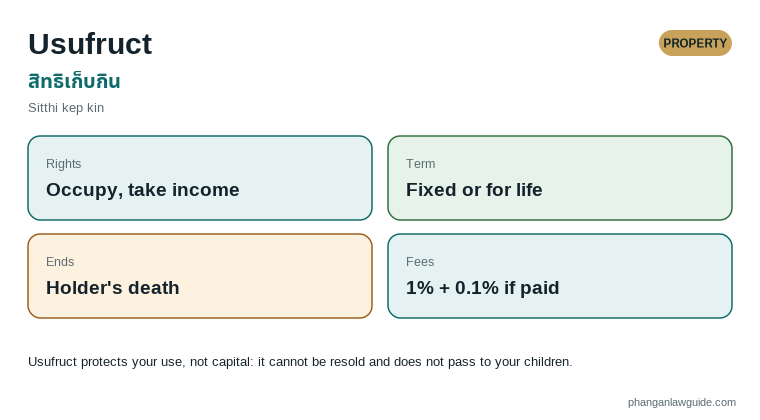
Usufruct is a real right: its holder may live in the property, rent it out and keep the income, while the owner keeps ownership. It is created in writing and is only complete once registered at the land office.
It can be granted for a set period or for the life of the holder. It ends on the holder's death and cannot be transferred. Registration costs 1% of the consideration plus 0.1% stamp duty; granted free of charge, it costs a few dozen baht.
Why does it matter on Koh Phangan?
On Koh Phangan, usufruct is mostly used by mixed couples: the land is in the Thai spouse's name, and the foreigner gets a lifetime usufruct to secure their home. It is also used to protect an elderly parent. Note that between spouses, a usufruct granted during the marriage does not fully protect you in a divorce.
Frequently asked questions
Can a foreigner hold a usufruct over Thai land?
Yes. The land office keeps some discretion, but usufructs are commonly registered for foreigners, especially spouses.
Can a usufruct be inherited by children?
No. It ends on the holder's death and cannot be transferred.
How much does registering a usufruct cost?
1% of the consideration plus 0.1% stamp duty; granted free, only minimal fixed fees apply.
Sources
- Thailand Law Online: usufruct (sections 1417 to 1428)
- Global Law Experts: lease, usufruct and superficies compared
- Chambers: Real Estate 2026, Thailand
Share
Related guides
 GlossarySuperficies: definitionThe right of superficies (sections 1410 to 1416) lets a foreigner own a house built on Thai land: term, registration…GlossaryRegistered lease: definitionA lease of more than 3 years must be registered at the Thai land office and cannot exceed 30 years: the rules, the…
 GlossaryTabien Baan: definitionThe Tabien Baan is the house registration of a home in Thailand: blue book for Thais, yellow book (Tor Ror 13) for…FamilyInheritance and a Thai willThai wills for foreigners, statutory heirs, the court and the estate administrator, inheriting a condo, land or a…