Superficies in Thailand: owning your house on someone else's land
On this page4
You lease the land for 30 years, but who owns the house you build on it? Without a superficies, it follows the land, so the Thai owner.
What is superficies?
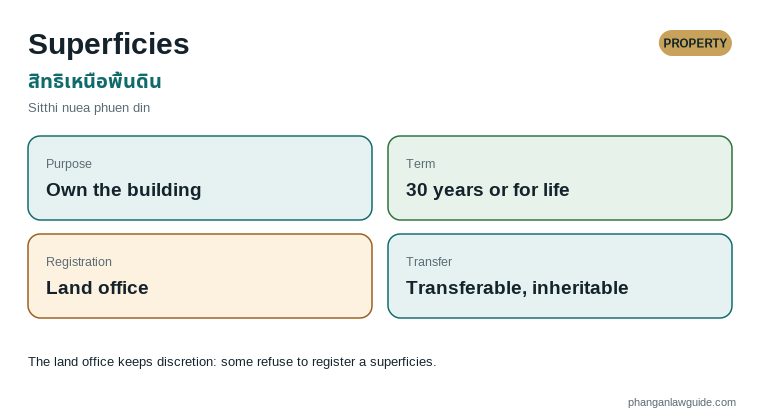
Under Thai law, what is built on land in principle belongs to the landowner. Superficies creates an exception: its holder owns the structures (house, pool, plantations) on another person's land.
It is granted for a fixed term of up to 30 years or for the life of the landowner or the holder. It must be registered at the land office to bind third parties. Unless the contract says otherwise, it can be transferred and inherited.
Why does it matter on Koh Phangan?
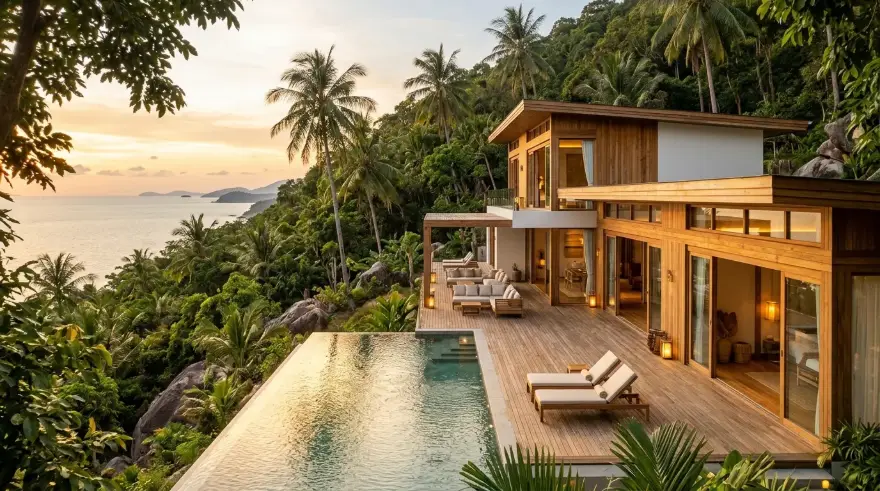
Villa buyers on the island often combine a registered lease on the land with a superficies on the house. This lets them resell the house with the remaining lease, and pass it to their heirs.
Frequently asked questions
Can a foreigner own a house in Thailand?
Yes, the building, separately from the land, notably through a registered superficies.
How long does a superficies last?
Up to 30 years, or for the life of the landowner or the holder.
Can a superficies be inherited?
Yes, unless the contract says otherwise, it can be transferred and inherited.
Sources
- Thai Law Online: superficies (sections 1410 to 1416)
- Global Law Experts: lease, usufruct and superficies compared
- Chambers: Real Estate 2026, Thailand
Share
Related guides
GlossaryRegistered lease: definitionA lease of more than 3 years must be registered at the Thai land office and cannot exceed 30 years: the rules, the… GlossaryUsufruct: definitionUsufruct (sections 1417 to 1428) gives the right to use property and take its income, often for life: what it…GlossaryChanote: definitionThe Chanote (Nor Sor 4 Jor) is the only true freehold land title in Thailand: what it proves, how to recognise it…FamilyMarrying a Thai nationalMarrying a Thai national: registration at the amphoe, the marriage visa (400,000 THB), separate and marital…