Renting a house long term on Koh Phangan: your rights as a tenant, the deposit and the traps
On this page6
Anna rents a house in Ban Tai for a year. She pays 6 months' rent as a deposit, "the island standard", the agent tells her. Electricity is billed at 9 baht per kilowatt-hour. When she leaves, the owner keeps the whole deposit for "painting and cleaning", with no inspection and no invoice.
None of this is allowed for a professional landlord. But you still need to know whether yours is one, and to have covered it in the contract.
Which rules protect tenants?
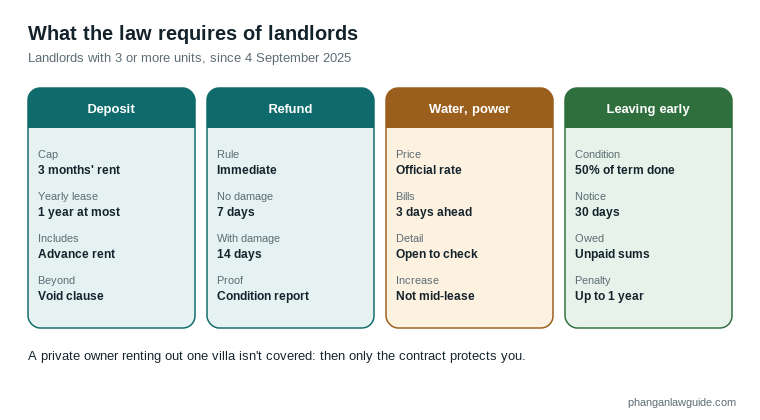
A notification of the Contract Committee, made under the Consumer Protection Act, has governed residential leases since 4 September 2025. It replaces a 2019 text.
- Capped deposit: deposit plus rent paid in advance may not exceed 3 months' rent, or 1 year for a long lease with yearly rent.
- Quick refund: the deposit is returned immediately at the end of the lease. If an inspection is needed, the deadline is 7 days with no damage, 14 days with damage, minus justified repair costs.
- Water and electricity: never above the official rate. Bills must be given in writing at least 3 days before they're due.
- Leaving early: in a fixed-term lease, you may leave after occupying at least half the term, with 30 days' notice.
- Condition report: a move-in report signed by both parties, with photos if possible, forms part of the lease.
Prohibited clauses are deemed void. A landlord in breach faces up to 1 year in prison and a 200,000 baht fine.
Who do these rules apply to?
Only landlords renting out at least 3 units are covered (5 under the old text). Hotels and dormitories fall under other laws.
That is the practical limit on Koh Phangan: many houses are rented by a private owner of a single villa. In that case the standard contract doesn't apply, and only your lease sets the deposit, charges and exit terms. Hence the importance of negotiating these points in writing from the start.
How do you rent safely on the island?
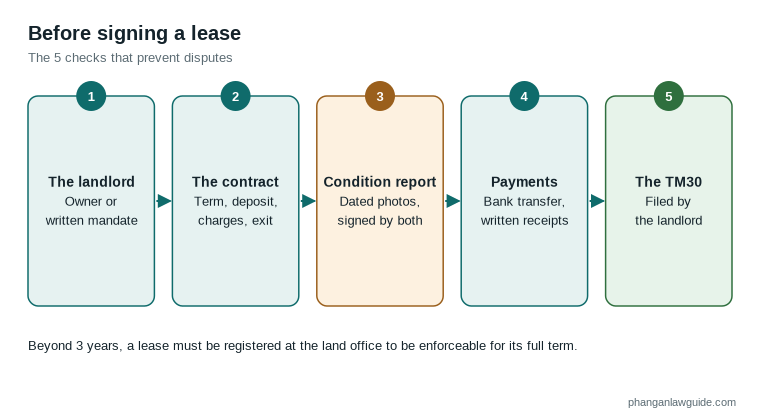
- Identify the landlord: the owner or someone with a written mandate. Ask for a copy of the title or the Tabien Baan.
- Read the contract: term, rent, deposit, charges, notice, exit terms, repairs.
- Do a condition report: dated photos of every room, signed by both parties.
- Pay traceably: bank transfer, or a written receipt for every cash payment.
- Check the TM30: the landlord must report your address to immigration within 24 hours of your arrival.
A lease of more than 3 years must be registered at the land office; otherwise it is only enforceable for 3 years.
What if the deposit isn't returned?
- Ask in writing for the refund, citing the deadlines and attaching the condition report.
- Demand proof for any deduction: repair quotes or invoices.
- Contact the Office of the Consumer Protection Board (OCPB) if the landlord rents out at least 3 units.
- For a small amount, a simplified procedure exists before the court.
Frequently asked questions
What deposit can a landlord ask for in Thailand?
For a landlord with 3 or more units: 3 months' rent at most, advance rent included (1 year for a lease with yearly rent). For a private owner, the contract decides.
How quickly must the deposit be returned?
Immediately at the end of the lease; if an inspection is needed, within 7 days without damage and 14 days with damage.
Can a landlord charge more for electricity?
No, not above the official rate, for a landlord with 3 or more units.
Can you leave a one-year lease early?
Yes, after occupying at least half the term, with 30 days' notice, if the landlord is subject to the 2025 rules.
Must a rental lease be registered?
Only beyond 3 years: it must then be registered at the land office to be enforceable for its full term.
Who files the TM30?
The landlord, within 24 hours of the foreign tenant's arrival.
Sources
- Tilleke & Gibbins: Thailand strengthens controls on residential leases (2025)
- Tilleke & Gibbins: residential leasing as a contract-controlled business
- Tilleke & Gibbins: 30-year leases and section 540 of the Civil Code
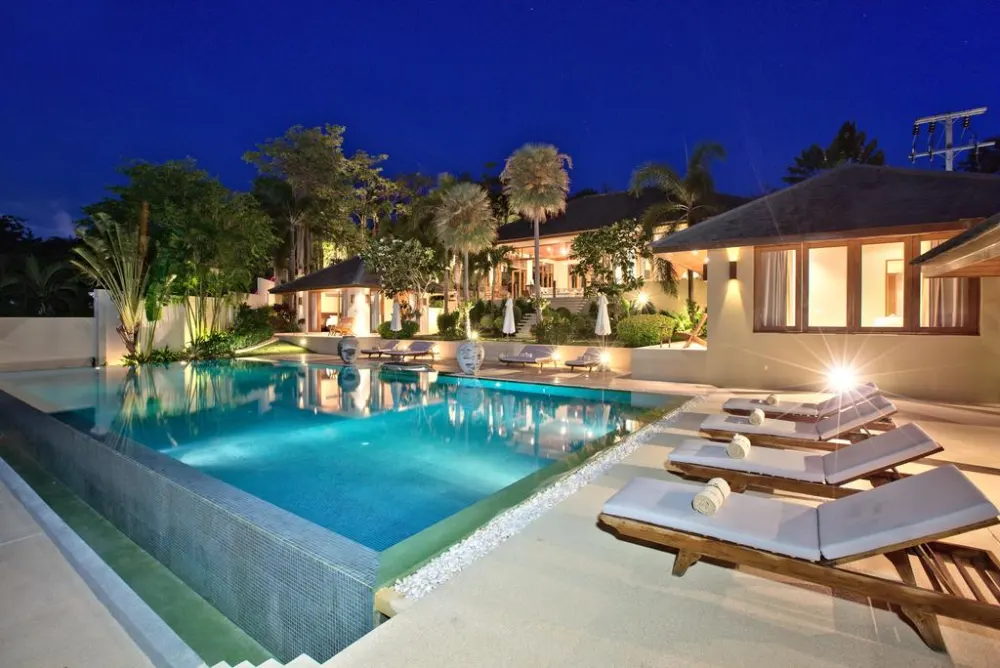
- Photo: pool villa, ChrisWDD, CC BY-SA 4.0, Wikimedia Commons.
Share
Related guides
 VisasTM30 and the 90-day reportTM30 within 24 hours by the host, the 90-day report (TM47) online or in person, travel and moving house, fines of…
 Property30+30+30 leases after 4655/2566Is a 30+30+30 lease still valid? What Supreme Court ruling 4655/2566 means for Koh Phangan villas, options for…
 PropertyProperty scams: the 8 trapsFake titles, public land, a "guaranteed" 90-year lease, the trusted compatriot: the 8 most common property scams on…
 VisasDTV visa: the 2026 rulesDTV visa: 500,000 THB, 180 days per entry, criminal record required since 31 Aug. 2026. Who qualifies, what it…