Buying a condo on Koh Phangan as a foreigner: the 49% quota, the FET transfer and the costs

On this page7
Clare found a sea-view one-bedroom near Thong Sala, advertised as "freehold". She paid the deposit in baht from her Thai account, then the balance in euros. At the land office, the officer refused to register the sale in her name: part of the price had not arrived in foreign currency from abroad, and the project had never been registered as a condominium. The "freehold" was only a lease.
A condo is the only way for a foreigner to own real estate outright in Thailand. But the rule is strict, and Koh Phangan's young market mixes genuine condominiums with plain leases.
Can a foreigner really own a condo in Thailand?
Yes. Unlike land, which a foreigner cannot own, a condominium unit can be held freehold, with no time limit, in your own name, with no company and no Thai partner. It is the only freehold real estate open to foreigners.
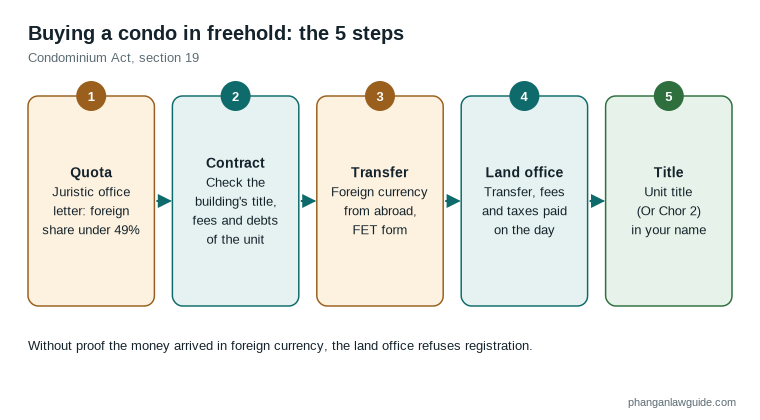
Two conditions under section 19 of the Condominium Act B.E. 2522 (1979):
- The building quota. Units owned by foreigners may not exceed 49% of the total floor area of the units in the building. The quota is measured by area, not by number of flats.
- Where the money comes from. The price must be paid with money brought into Thailand from abroad in foreign currency (euros, dollars, pounds…), converted to baht in Thailand.
How does the 49% quota work?
The building's juristic person keeps the register of units owned by foreigners. Before signing, ask for a letter confirming the foreign quota has not been reached and that enough area remains for your unit. On transfer day, the land office checks this.
If the quota is full, only weaker options remain: a 30-year lease on a unit in the Thai quota, or waiting for another foreigner to sell. Beware of set-ups that put the unit in a Thai person's name on your behalf: that is a nominee, illegal and risky.
How do you prove the money came from abroad?
This is the mistake that blocks most sales on the day:
- Send the money from an account abroad, in foreign currency, to your Thai account or the seller's. A transfer in baht from abroad can fail the test.
- State the purpose as "purchase of a condominium unit", with the project name and unit number if possible.
- For transfers of USD 50,000 or more, the Thai bank issues an FET form (Foreign Exchange Transaction Form, formerly "Thor Tor 3"). Below that, ask the bank for a letter confirming the source of funds.
- The amount proven must cover at least the declared price.
Keep several copies: without this document, the land office refuses to register the transfer.
What fees and taxes are paid at the land office?
Everything is settled on transfer day, usually by cashier's cheque:
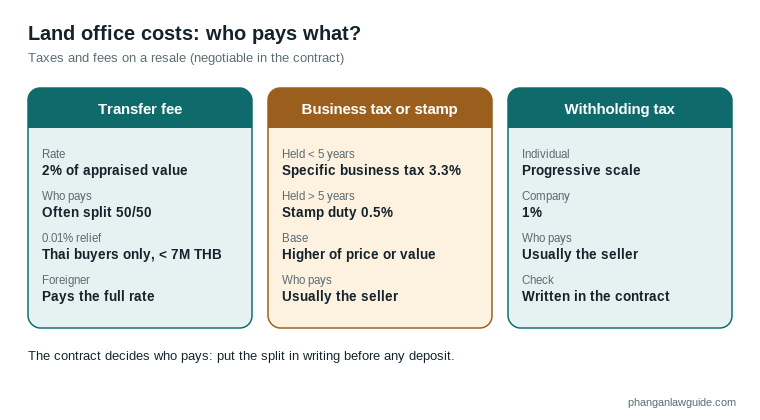
- Transfer fee: 2% of the appraised value, often split equally. The 0.01% relief in force from 1 July 2026 to 30 June 2027 only covers residential property under 7 million THB bought by Thai individuals: a foreigner pays the 2%.
- Specific business tax of 3.3% if the seller resells within 5 years of buying, otherwise stamp duty of 0.5%. Usually paid by the seller.
- Withholding tax on the seller's gain (progressive scale for an individual, 1% for a company).
The law does not say who pays what: the contract decides. Put the split in writing before the deposit.
Land office cost calculator
Condo, house or property rights: who pays what on transfer day.
Indicative simulation only, not a substitute for advice from a licensed lawyer or accountant.
Which traps are specific to Koh Phangan?
The island's condo market is still small, and many recent projects are villa or "apartment" resorts that are not registered under the Condominium Act. In that case no unit title can be issued in your name: you are only buying a lease, whatever the word "freehold" in the listing.
So check:
- that the building is registered as a condominium at the land office, and that each unit will have its own unit title (Or Chor 2);
- the land title of the building plot (ideally a Chanote) and that the developer's mortgage is cleared;
- for an off-plan purchase, the payment schedule, the building permit and what happens if construction stops;
- the condominium rules: they often ban nightly rentals.
Frequently asked questions
Can a foreigner own a condo freehold in Thailand?
Yes, in their own name and with no time limit, if foreign ownership in the building does not exceed 49% of the units' floor area and the price was paid with money brought in from abroad in foreign currency.
What is the FET form?
It is the document a Thai bank issues for an incoming foreign-currency transfer of USD 50,000 or more. It proves to the land office that the condo price came from abroad.
Can I pay for a condo in baht?
Only if the baht come from foreign currency sent from abroad and converted in Thailand, with bank proof. Baht earned or borrowed in Thailand do not allow the unit to be registered in a foreigner's name.
What if the building's foreign quota is full?
Wait for another foreigner to sell, or take a 30-year lease on a unit in the Thai quota. Do not put the unit in a Thai person's name on your behalf: that is a nominee arrangement.
Do foreigners get the 0.01% transfer fee reduction?
No. The relief in force until 30 June 2027 covers residential property under 7 million THB bought by Thai individuals. A foreign buyer pays the 2%.
Is a "freehold apartment" on Koh Phangan always a condo?
No. Without registration of the building under the Condominium Act and a unit title in your name, it is generally a lease, even if the listing says "freehold".
Sources
- Terms.law: the 49% foreign quota and section 19 of the Condominium Act
- ThaiLawOnline: property transfer fee and taxes in Thailand
- Thairath: transfer fees cut to 0.01% until 30 June 2027
- Benoit & Partners: buying property on Koh Phangan
- Global Law Experts: transferring a condo to a foreign buyer (2026)
- The Thaiger: what the 49% foreign quota means for buyers
Share
Related guides
 PropertyBuying costs and taxes: who pays what?A 2% transfer fee, 3.3% business tax or 0.5% stamp duty, 1.1% to register a lease, yearly land tax: the real cost of…
 PropertyCheck a property before you buyFree tool: check the title, seller, access, forest, structure and payment before you buy or lease on Koh Phangan.…Property30+30+30 leases after 4655/2566Is a 30+30+30 lease still valid? What Supreme Court ruling 4655/2566 means for Koh Phangan villas, options for…GlossaryFET form: definitionThe FET form proves that condo purchase money came from abroad in foreign currency: the USD 50,000 threshold, the…