Building your villa on Koh Phangan: building permits, zones and traps for a foreigner
On this page7
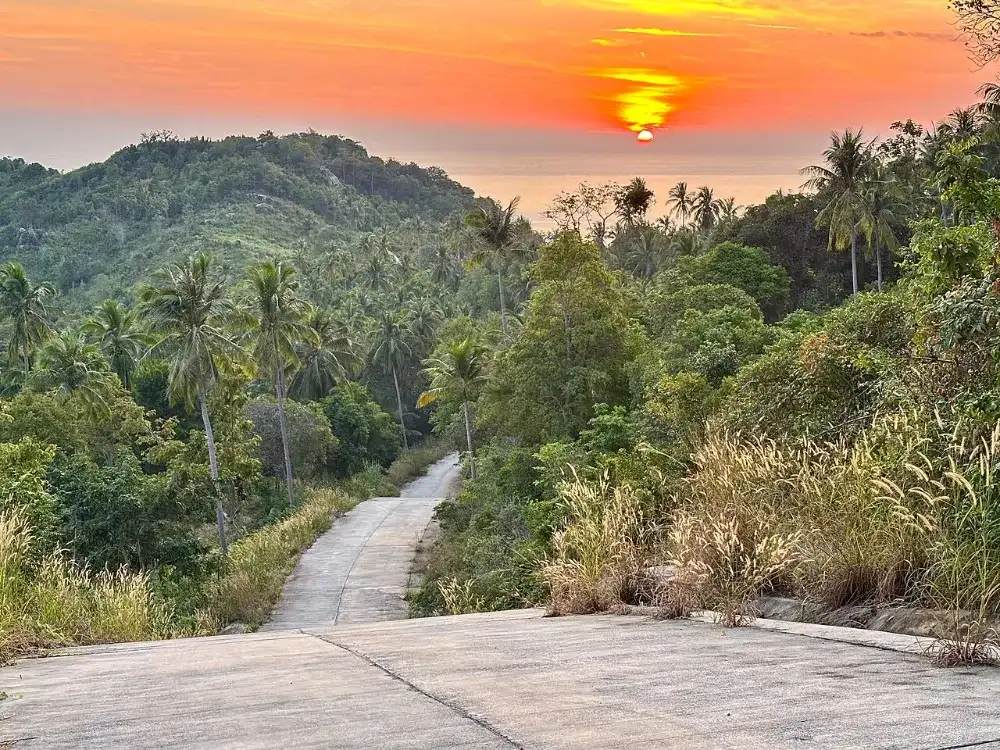
Stefan buys a 30-year lease on a hill above Haad Salad: stunning view, steep plot. His contractor promises a three-storey villa, "no problem, everyone does it". Two years later, an inspection records a height of 10 metres on a slope steeper than 35%. The permit, in the contractor's name, doesn't match the plans. Stefan receives a partial demolition order.
On the Gulf islands this is not theoretical: on Koh Samui, the municipality has already demolished luxury villas built above the permitted height.
Who issues the building permit?
Construction is governed by the Building Control Act of 1979. Its section 21 makes building without a permit an offence.
- The authority: the municipality (tessaban) or the Or Bor Tor, the sub-district administration.
- The form: the building permit, called Or. 1 (อ.1).
- The file: plans signed by a licensed architect and engineer, structural calculations, a copy of the land title and the landowner's written consent.
Preparing the signed plans often takes longer than the permit approval itself.
Why should the permit be in your name?
In Thailand, there is no title deed for a house. Land is registered at the land office; buildings are not, unless a superficies is registered.
For a foreigner building on leased land, the building permit in their name does two jobs: it authorises the works and it proves the house belongs to them, not to the landowner. Together with the construction contract and the invoices paid from their account, it protects them if the land is sold, the relationship ends or the lessor dies.
How does a building project unfold?
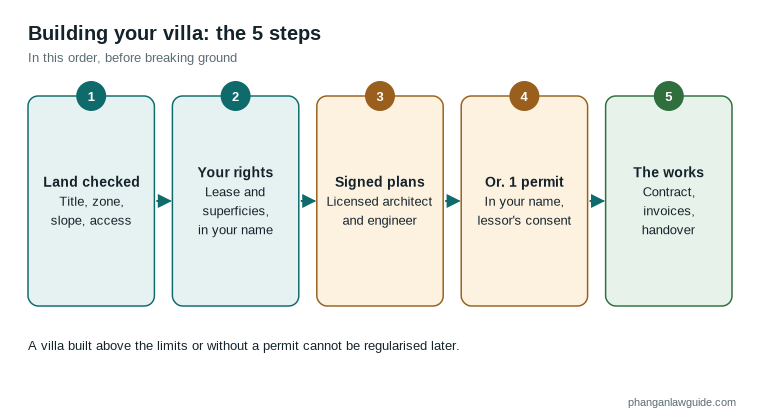
- Check the land: title (Chanote or Nor Sor 3 Gor), altitude, slope, legal access, distance to forest and beach.
- Register your rights: a 30-year lease and a superficies in your name, at the land office.
- Have the plans drawn by a licensed architect and engineer, following the zone's rules.
- Get the Or. 1 permit in your name, with the landowner's written consent.
- Supervise the works: written contract, staged payments, invoices, handover matching the plans.
What can you build, and where?
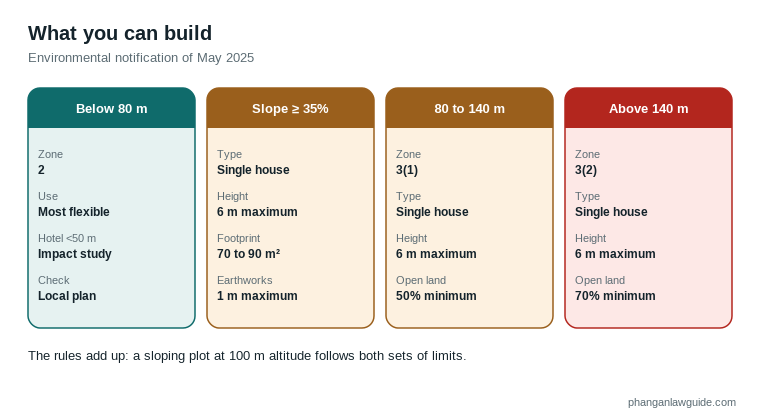
Since 22 May 2025, an environmental notification covers Koh Samui, Koh Phangan and Koh Tao. It applies even before the building law does, and stays in force until May 2030.
- Below 80 m altitude (zone 2): the most flexible zone, but a hotel or building within 50 m of the shore needs a full impact study.
- Between 80 and 140 m (zone 3(1)): single house only, 6 m high at most, at least 50% of the plot left open.
- Above 140 m (zone 3(2)): same rules, with at least 70% of the plot open.
- Slope of 35% or more: single house up to 6 m, limited footprint (70 to 90 m² depending on plot size) and earthworks limited to 1 m.
The rules add up: a sloping plot at 100 m altitude follows both sets of limits. Local town plans may add constraints of their own.
What are the risks of building without a permit or outside the limits?
Building without a permit or off-plan exposes you to a stop-work order, fines and, in the worst cases, a demolition order. On Koh Samui, investigations found that most of 52 hilltop villas had no permits, and the municipality demolished villas that reached over 10 m instead of the 6 m allowed.
The problem also surfaces on resale: an informed buyer will ask for the permit and walk away from a villa that is too high or too close to the beach. A villa outside the limits cannot be regularised later; it loses much of its value.
Frequently asked questions
Can a foreigner get a building permit in Thailand?
Yes. If they hold a registered lease, usufruct or superficies, they can apply in their own name, with the landowner's written consent.
Who issues building permits on Koh Phangan?
The local authority: the municipality (tessaban) or the Or Bor Tor, depending on the part of the island.
What is the maximum height for a villa on Koh Phangan?
6 m above 80 m altitude or on a slope of 35% or more. Lower down, local rules set the height.
Can you build on a slope steeper than 50%?
The 2025 text doesn't ban building above 50%, but it caps the house at 6 m, reduces the footprint and requires large trees to be protected.
What happens if you build without a permit?
Works can be stopped, fines imposed and, in serious cases, demolition ordered.
Can a building permit be transferred?
Yes, it can be transferred from one person to another during construction, through the authority that issued it.
Sources
- ThaiLawOnline: the Or. 1 building permit and the 1979 Act
- ThaiLawOnline: building permits as proof of ownership
- Aster of Asia: building permits, procedure and risks
- Lex Bangkok: the May 2025 zoning rules for Samui and Phangan
- Bangkok Post: hilltop villas without permits on Koh Samui
- The Thaiger: Koh Samui demolishes oversized villas
- Photo: steep road on Koh Phangan, kallerna, CC BY-SA 4.0, Wikimedia Commons.
Share
Related guides
 PropertySuperficies and usufruct: owning your houseA foreigner can't own land but can own their house: superficies, usufruct, habitation and leases, and what each…
 PropertyChanote vs Nor Sor 3 Gor: which land title?Chanote, Nor Sor 3 Gor, Nor Sor 3, Sor Kor 1, Por Bor Tor 5: what each Thai land document is worth on Koh Phangan,…
 PropertyProperty scams: the 8 trapsFake titles, public land, a "guaranteed" 90-year lease, the trusted compatriot: the 8 most common property scams on…
 PropertyBuying costs and taxes: who pays what?A 2% transfer fee, 3.3% business tax or 0.5% stamp duty, 1.1% to register a lease, yearly land tax: the real cost of…