Property buying costs and taxes in Thailand: what you will really pay on Koh Phangan
On this page6
Sophie negotiated her Srithanu villa down to the last baht. On registration day at the land office, the officer announced a sum she had never seen in the contract: the transfer fee the seller "thought" they would share, and the lease registration, calculated on thirty years of rent. Nobody had written down who paid what. The signing was pushed back a week.
Buying costs in Thailand are modest compared with Europe. But they are all settled on the same day, in cash or by bank cheque, and it is the contract, not the law, that decides who pays them.
Which fees are paid at the land office?
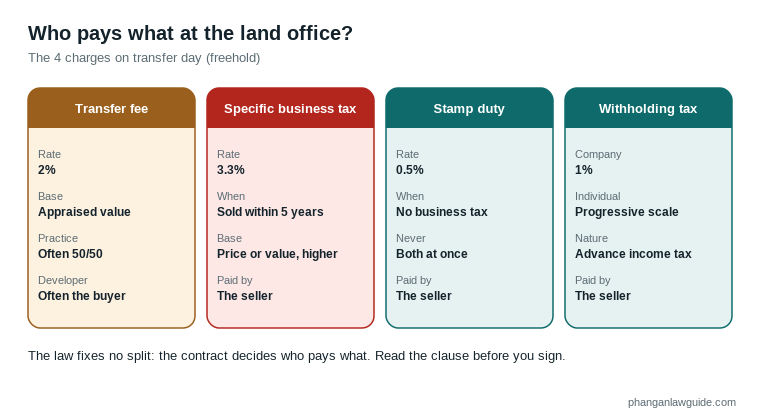
Four charges can fall due on the day a freehold property is transferred:
- The transfer fee: 2% of the appraised value set by the Land Department, often lower than the real price. In resales it is often split equally; developers frequently ask the buyer to pay it all.
- The specific business tax: 3.3%, i.e. 3% plus a 10% local tax on that amount. It applies if the seller sells within 5 years of buying, or trades in property as a business. It is charged on the higher of the declared price and the appraised value.
- Stamp duty: 0.5%, only when the specific business tax does not apply. The two are never charged together.
- Withholding tax: an advance on the seller's income tax, 1% for a company, on a progressive scale for an individual.
The most common split: transfer fee shared, business tax or stamp duty and withholding tax paid by the seller. But nothing is automatic.
Does the 0.01% reduction apply to foreigners?
No. The government has extended to 30 June 2027 the cut in transfer and mortgage fees to 0.01%. But it is reserved for individual Thai nationals, for homes up to THB 7 million. A foreign buyer pays the full 2%.
Be wary of listings that calculate your costs "at 0.01%": they quote a figure that does not apply to you.
What does a lease, a superficies or a usufruct cost?
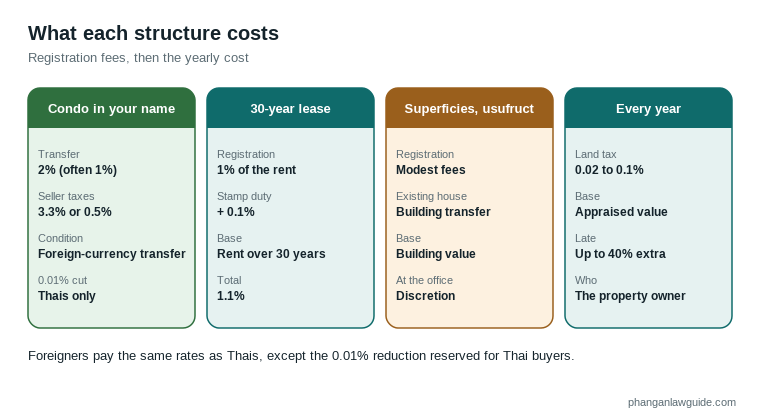
A foreigner cannot own land. For a villa, you usually register a lease on the land, and sometimes a superficies to own the house.
- Lease over 3 years: registration is mandatory, 1% of the total rent for the whole term, plus 0.1% stamp duty, i.e. 1.1%. On a 30-year lease at THB 300,000 a year (THB 9 million in total), expect about THB 99,000.
- Superficies or usufruct: registration fees are modest. But if the house already exists, the land office may require the building to be transferred first, with its own fees and taxes based on its value.
- Freehold condo: the same costs as above (2%, then 3.3% or 0.5%, plus withholding), provided the price arrived from abroad in foreign currency.
Is there a yearly property tax?
Yes. Since 2020, the land and building tax applies to every owner, foreigners included, on the appraised value. For most homes, the rates applied range from 0.02% to 0.1%. A main residence registered in the house book enjoys exemptions up to certain thresholds; a second home or a rented property is taxed from the first baht, at 0.02%.
Paying late is expensive: a surcharge of up to 40% and 1% interest a month. The assessment comes each year from the municipality (Tessaban or OrBorTor); if it doesn't reach you, go and get it.
Frequently asked questions
Are there notary fees in Thailand?
No. There is no notary: fees are paid directly at the land office on transfer day, and the contract says who pays them.
Who pays the transfer fee in Thailand?
The law doesn't say. In resales it is often split 50/50; developers often ask the buyer to pay it in full.
Does a foreigner pay more tax than a Thai?
No, the rates are the same, except the temporary 0.01% reduction reserved for Thai buyers.
How much does it cost to register a 30-year lease?
1% of the total rent for the whole term, plus 0.1% stamp duty, i.e. 1.1%.
Do you pay both the business tax and stamp duty?
Never both: the 3.3% specific business tax applies if the property is resold within 5 years, otherwise the 0.5% stamp duty applies.
Is there a yearly property tax in Thailand?
Yes, the land and building tax, 0.02% to 0.1% of the appraised value for most homes, paid each year to the municipality.
Sources
- Chambers, Real Estate 2026: taxes on a sale
- ThaiLawOnline: transfer fee, business tax, stamp duty and withholding (updated September 2026)
- Forvis Mazars: 0.01% fees extended to 30 June 2027, Thai nationals only
- Nation Thailand: fee reduction extended, June 2026
- ThailandLawOnline: lease registration, 1% plus 0.1% stamp duty
- ThaiLawOnline: Land and Building Tax Act B.E. 2562, rates and penalties
- Photo: Phetchaburi land office, KengCH, CC BY-SA 3.0, Wikimedia Commons.
Share
Related guides
 PropertyChanote vs Nor Sor 3 Gor: which land title?Chanote, Nor Sor 3 Gor, Nor Sor 3, Sor Kor 1, Por Bor Tor 5: what each Thai land document is worth on Koh Phangan,…
 PropertyBuying a condo: the 49% quotaA foreigner can own a Thai condo freehold: the 49% quota, the foreign-currency transfer and FET form, the 2% fee,…
 Property30+30+30 leases after 4655/2566Is a 30+30+30 lease still valid? What Supreme Court ruling 4655/2566 means for Koh Phangan villas, options for…
 PropertyBuilding your villa: permits and zonesA building permit (Or. 1) in your name, altitude zones, 35% slopes, a 6 m height cap: what a foreigner must know…