Divorcing in Thailand as a foreigner: at the amphur or in court, property, children and your visa
On this page6
Thomas has been married for eight years to Nok, whom he met on Koh Phangan. Together they bought land in Ban Tai, in Nok's name, and built a house. When they divorce, Thomas finds he signed a declaration at the land office saying the money for the land belonged to his wife.
Under Thai law, that land is therefore Nok's personal property. Recovering his share will be, at best, very hard.
Where can you divorce?
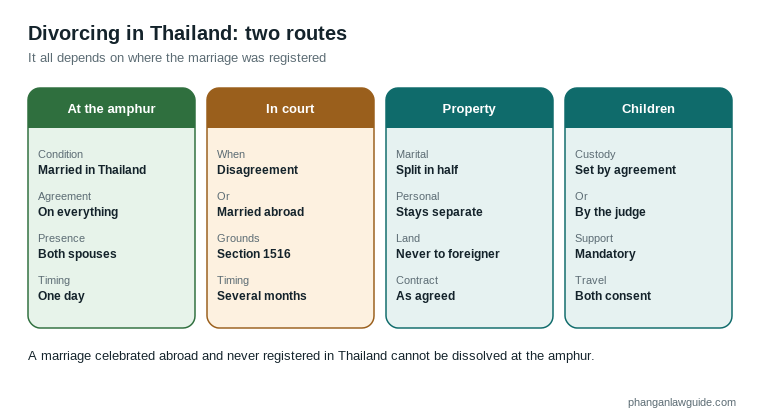
At the amphur, by mutual consent This is the simplest route: both spouses go together to the district office with their ID, the marriage certificate and a written agreement on property and children. The divorce is registered the same day, for minimal administrative fees.
But it is only open to marriages registered in Thailand. A marriage celebrated abroad and never registered cannot be dissolved at the amphur, even if both spouses agree.
In court A court divorce is required if one spouse refuses, if disagreement persists over property or children, or if the marriage took place abroad. You must then cite one of the grounds set out in section 1516 of the Civil and Commercial Code. A contested case takes several months on average.
What are the grounds for a court divorce?
Section 1516 lists about a dozen, including:
- adultery or keeping another person as a spouse;
- serious misconduct causing shame, harm or ill-treatment;
- desertion for more than a year;
- voluntary separation for more than 3 years;
- failure to support or maintain the spouse;
- disappearance for more than 3 years, or a prison sentence.
How is property divided?
Thai law distinguishes two categories:
- personal property (sin suan tua): what each spouse owned before the marriage, inheritances or gifts, personal effects. It stays with its owner.
- marital property (sin somros): what was acquired during the marriage, including income from personal property. It is in principle split in half (section 1533), unless there is a prenuptial agreement.
A prenuptial agreement is only valid if registered at the same time as the marriage.
Land raises a particular problem. A foreigner can't own land: land bought during the marriage is in the Thai spouse's name. At the land office, the foreigner usually signs a declaration that the money belongs to their spouse, which makes the land the Thai spouse's personal property. If they prove instead that the land is marital property, the judge may order it sold and the price shared.
What should you do before divorcing?
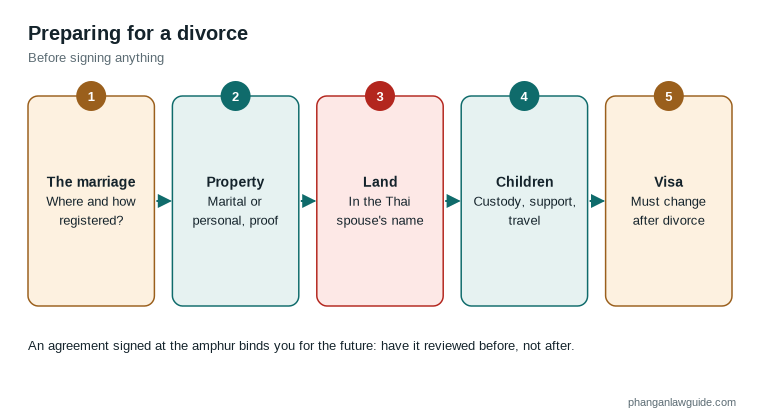
- Check your marriage: where it was celebrated, whether it is registered in Thailand, whether there is a prenup.
- List the property: marital or personal, with proof (statements, invoices, deeds).
- Look at real estate: land in the spouse's name, lease, superficies, condo.
- Arrange for the children: custody, parental authority, support, travel consent.
- Plan your visa: the marriage-based extension ends; you will need another visa.
The agreement signed at the amphur binds you for the future: have it reviewed before you sign.
Frequently asked questions
Can you divorce quickly in Thailand?
Yes, at the amphur, in one day, if the marriage is registered in Thailand, both spouses attend and they agree on everything.
Can you divorce in Thailand from a marriage celebrated abroad?
Yes, but only in court, even if both spouses agree.
How is property divided in a Thai divorce?
Property acquired during the marriage is in principle split in half; property owned before or inherited stays with each spouse.
What happens to land in the Thai spouse's name?
It stays with the Thai spouse if it is treated as their personal property. If it is marital, the judge may order it sold and the price shared.
Who gets custody of the children?
The parents set it in their agreement; otherwise the judge decides in the child's interest.
What happens to my visa after the divorce?
The marriage-based extension of stay ends. You must obtain another visa or leave the country.
Sources
- Tilleke & Gibbins: divorce in Thailand for foreign couples
- Thailand Starter Kit: divorcing in Thailand, property, children and visa
- Chiang Rai Times: the two routes, section 1516 and section 1533
- Juslaws: divorcing from a marriage registered abroad
- ThaiLawOnline: guide to divorce in Thailand
Share
Related guides
 FamilyMarrying a Thai nationalMarrying a Thai national: registration at the amphoe, the marriage visa (400,000 THB), separate and marital…FamilyInheritance and a Thai willThai wills for foreigners, statutory heirs, the court and the estate administrator, inheriting a condo, land or a…FamilyBirth and your child's nationalityRegistration at the amphur within 15 days, the right of blood, a child of an unmarried foreign father, passport and…
 DisputesArrested in Thailand: your rights48 hours in police custody, court-ordered detention of up to 84 days, the right to a lawyer and interpreter, bail,…