Giving birth in Thailand: registering the child, nationality and visa when a parent is a foreigner

On this page6
Léa gives birth to a baby boy at the hospital in Thong Sala. Her partner, Arthur, is French like her. Convinced the baby "is Thai because he was born here", they wait two months before dealing with the paperwork. When they leave for France for the holidays, the airline refuses to board the child: he has neither a passport nor a permission to stay.
A child born in Thailand to two foreign parents isn't Thai. They need papers from their own country, and a status in Thailand.
How do you register the birth?
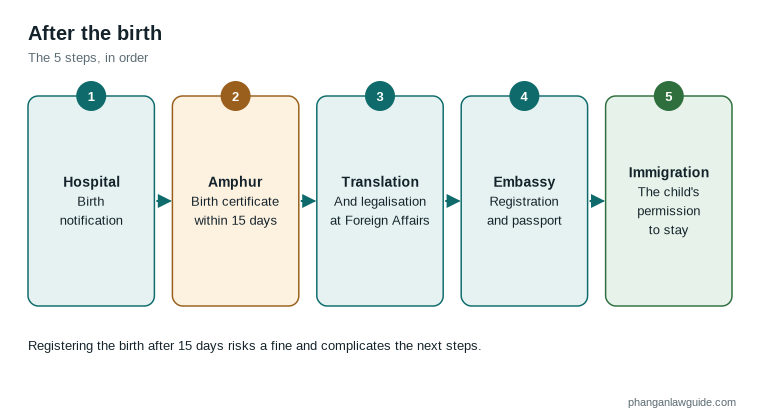
- At the hospital: the hospital issues a birth notification.
- At the amphur: register the birth within 15 days at the district office where the child was born, with the notification and the parents' passports. The amphur issues the Thai birth certificate. Late registration risks a fine.
- Translation and legalisation: have the certificate translated and the translation legalised by the Thai Ministry of Foreign Affairs.
- At the embassy: have the birth recorded in your country's civil register and apply for the child's passport.
- At immigration: regularise the child's stay, usually with a visa or extension linked to a parent's.
Will the child be Thai?
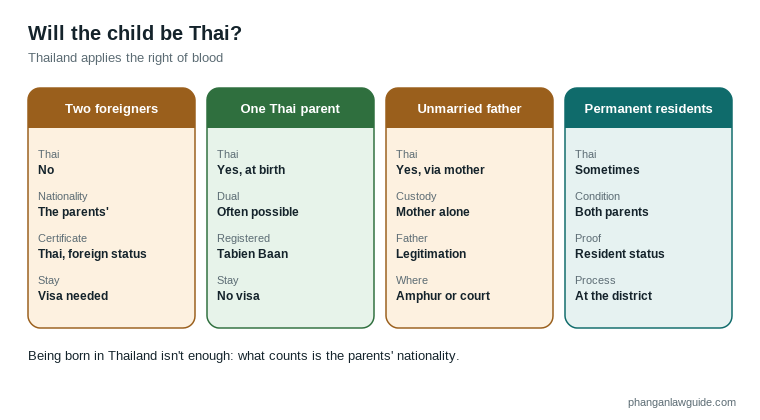
Thai nationality law rests on the right of blood:
- One Thai parent: the child is Thai from birth, whether born in Thailand or abroad. They can often keep the other parent's nationality too.
- Two foreign parents: the child isn't Thai. The Thai birth certificate records their foreign nationality.
- Permanent residents: in some cases, the child of two permanent-resident parents can obtain Thai nationality.
Being born in Thailand is therefore not enough.
What if the foreign father isn't married to the mother?
This is the least-known point. Under Thai law, a child born to unmarried parents is the legitimate child of the mother only. Even if he appears on the birth certificate, the father has no parental authority until the child is legitimated:
- by the parents' later marriage;
- by registration at the amphur, with the consent of the mother and the child (depending on age);
- by a court judgment if the mother or child cannot or will not consent.
Without legitimation, the father can't decide alone on schooling or medical care, or take the child abroad, and his position is fragile if the couple separates or the mother dies.
What permission to stay does the child need?
A foreign child born in Thailand has no entry stamp. In practice, immigration doesn't penalise children under 15, but the child must obtain a status before travelling: most often a non-immigrant O visa or an extension linked to a parent's visa (work, retirement, marriage). Keep the Thai birth certificate with the passport: it proves the child was born here.
Frequently asked questions
Is a child born in Thailand Thai?
Only if one of their parents is Thai. A child of two foreign parents isn't Thai, save for special cases.
How long do you have to register a birth in Thailand?
15 days, at the amphur where the child was born.
Can my child have dual nationality?
A child of one Thai and one foreign parent can often hold both, depending on the other parent's country's law.
Does an unmarried foreign father have rights over the child?
No parental authority until the child is legitimated, by marriage, registration at the amphur or a court judgment.
Does the baby need a visa?
Immigration doesn't penalise a child under 15 born locally, but they must obtain a permission to stay before travelling.
Where do you get the child's passport?
From your country's embassy or consulate, after the birth has been recorded.
Sources
- Wikipedia: Thai nationality law (right of blood, right of soil)
- National Statistical Office: 15-day deadline to register a birth
- Fragomen: starting a family in Thailand, the child's status
- Baker McKenzie: Thai nationality of a child with a Thai parent
- The Thailand Life: foreign children born in Thailand
Share
Related guides
FamilyMarrying a Thai nationalMarrying a Thai national: registration at the amphoe, the marriage visa (400,000 THB), separate and marital… FamilyDivorcing in ThailandA one-day divorce at the amphur or a court divorce on one of the section 1516 grounds, splitting marital property,…FamilyInheritance and a Thai willThai wills for foreigners, statutory heirs, the court and the estate administrator, inheriting a condo, land or a…
 DisputesArrested in Thailand: your rights48 hours in police custody, court-ordered detention of up to 84 days, the right to a lawyer and interpreter, bail,…