Arrested in Thailand: your rights as a foreigner, the first 48 hours, bail and your embassy

On this page6
Kevin is leaving a party in Haad Rin when a police check stops him. He is taken to the station and handed a document in Thai to sign "so you can get out faster". Exhausted, he signs. He later learns that the document amounted to a confession.
The first hours of an arrest often decide what follows. Knowing your rights beforehand avoids the costliest mistake.
What happens after an arrest?
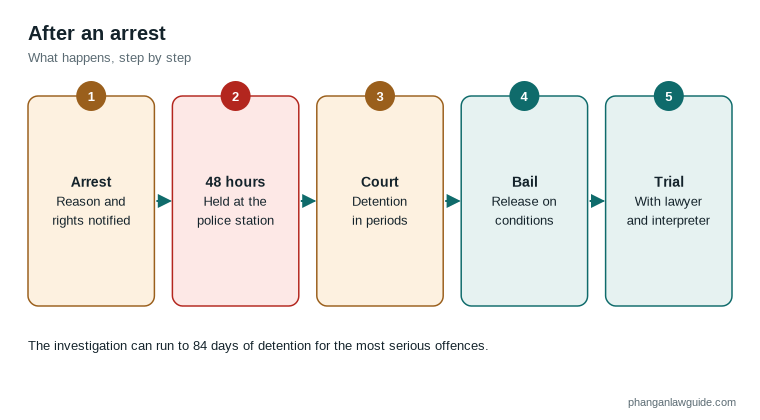
- The arrest: police must tell you the reason and your rights.
- Police custody: 48 hours at most at the station, for investigation and questioning.
- The court: beyond 48 hours, police must ask a judge for pre-trial detention, granted in successive periods. For the most serious offences, the investigation can run to 84 days of detention in total.
- Bail: release on bail can be requested at the station or in court; it is available for most offences, often with a ban on leaving the country.
- The trial: conducted in Thai, with an interpreter. There is no jury.
A conviction may be followed by deportation and a re-entry ban.
What are your rights?
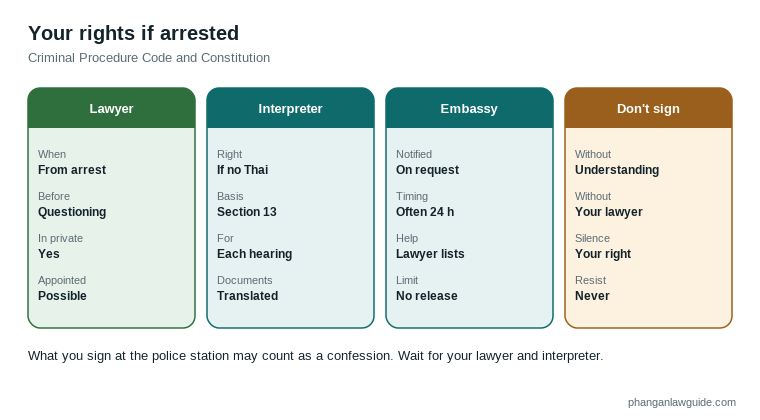
- The right to a lawyer: from arrest, including before questioning, and in private. A lawyer may be appointed in some cases.
- The right to an interpreter if you don't understand Thai (section 13 of the Criminal Procedure Code).
- Notification of your embassy: ask for it explicitly. It often happens within 24 hours, sometimes later. The embassy can give you a list of lawyers and inform your family, but cannot get you released.
- The presumption of innocence, guaranteed by the Constitution.
- The right not to sign a document you don't understand.
What to do, and not do, in the first hours?
- Stay calm and never resist physically: resisting is an offence in itself.
- Ask for a lawyer and an interpreter before any questioning.
- Ask for your embassy to be notified.
- Sign nothing you don't understand: a signed statement may count as a confession.
- Don't offer money to an officer: bribery makes things worse.
- Have someone close to you informed, so they can contact a lawyer and prepare bail.
How much is bail?
It depends on the offence and the penalty it carries. Guideline scales exist, but the judge has discretion. Bail can be paid in cash, with a title deed or through bail insurance. A foreigner often has their passport withheld and is barred from leaving the country until judgment.
Frequently asked questions
How long can police hold a foreigner in Thailand?
48 hours at most before bringing them before a judge. Beyond that, detention must be authorised by the court.
Do you have the right to a lawyer in Thailand?
Yes, from arrest, including before questioning.
Can my embassy get me released?
No. It can give you a list of lawyers, inform your family and check your conditions of detention, but it can't intervene in the case.
Can you get bail in Thailand?
Yes, for most offences, often with the passport withheld and a ban on leaving the country.
Should you sign the police statement?
Not without understanding it, with an interpreter, and ideally with your lawyer present.
Does a conviction lead to deportation?
Often, after the sentence, with a ban on returning to Thailand.
Sources
- ThaiLawOnline: your rights as a foreigner if arrested
- ThaiLawOnline: detention, 48 hours and 84 days
- ThaiLawOnline: interpreters and section 13 of the Criminal Procedure Code
- UK government: information pack for British nationals arrested in Thailand
- Government of Canada: overview of the criminal law system in Thailand
- Photo: Haad Rin, Koh Phangan, Fabio Achilli, CC BY 2.0, Wikimedia Commons.
Share
Related guides
 DisputesScooter accident: what to do?Scooter accident on Koh Phangan: the 5 reflexes, motorbike licence and IDP, Por Ror Bor, rental cover, police,…
 VisasOverstaying your visa500 baht a day, capped at 20,000, a 1 to 10-year ban beyond 90 days, 5 years if you're caught: the Thailand overstay…
 BusinessNominee crackdown 2025–2026Why Thailand is raiding nominee companies on Koh Phangan: figures, penalties, how investigators work and what villa…
 VisasOpening a Thai bank accountSince 2025, Thai banks turn away most tourists and DTV holders. Which visa lets you open an account, what to bring,…