Setting up a company in Thailand as a foreigner: structure, capital, shareholders and traps on Koh Phangan

On this page6
Adrien wants to open a café in Srithanu. A "consultant" offers him a turnkey company in a week: two Thai shareholders holding 51% whom he will never meet, preference shares to keep him in control, and a declared capital of 2 million baht "that nobody checks".
That structure was common ten years ago. Since 2025, it is exactly what police raids on the island are looking for.
Which structure should you choose?
Almost every foreigner uses the private limited company (Company Limited, บริษัทจำกัด):
- at least 2 shareholders, individuals or companies;
- at least 1 director, who may be a foreigner;
- liability limited to the value of the shares;
- online registration with the DBD, for a 5,500 baht fee.
A foreigner cannot register a sole proprietorship in Thailand. Representative offices and branches of foreign companies exist, but rarely suit a local business on the island.
How much can foreigners hold?
It all depends on the activity. The 1999 Foreign Business Act (FBA) sorts activities into three lists:
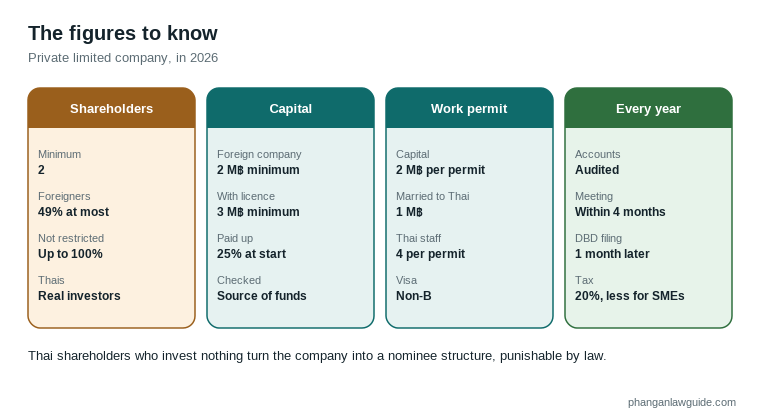
- unrestricted activity (manufacturing, export…): up to 100% foreign, with 2 million baht minimum capital;
- restricted activity (List 3: most services, hotels, trade, restaurants): 49% foreign at most, unless you hold an FBL licence, BOI promotion or the Treaty of Amity;
- prohibited activities (List 1: land, media, rice farming…): no exceptions.
On Koh Phangan, almost every project (villa rental, café, yoga school, agency) falls under List 3.
How does the set-up work?
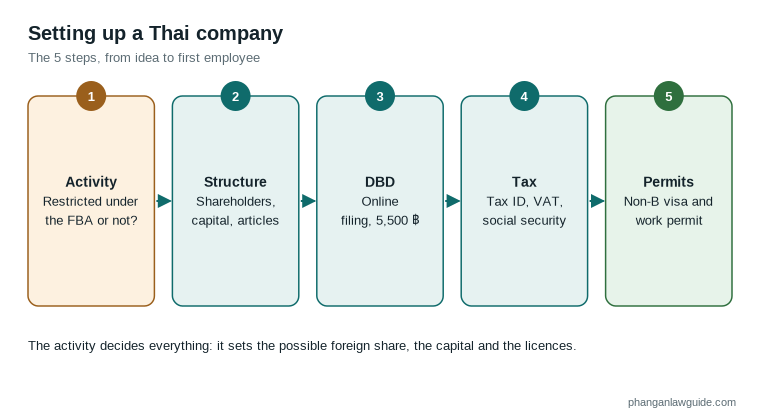
- Classify the activity: restricted or not, licence needed or not (hotel, restaurant, travel agency…).
- Set the structure: shareholders, split, capital, directors, signing powers.
- Register the company with the DBD: name reservation, memorandum, statutory meeting, registration, often within a few days.
- Register for tax: tax ID, VAT if turnover exceeds 1.8 million baht, social security from the first employee.
- Get the permits: non-immigrant B visa and work permit for every foreigner working, trade licences.
Capital has no general legal minimum, but at least 25% must be paid up at incorporation. For a foreign-majority company, 2 million baht (3 million with a licence) must actually be contributed.
Why must Thai shareholders be real?
A Thai shareholder holding 51% on behalf of a foreigner, without investing or deciding anything, is a nominee. The FBA punishes the nominee and the foreigner using them: up to 3 years in prison and 100,000 to 1 million baht in fines, plus a daily fine and possible dissolution of the company.
Since 2025, the DBD has checked the source of funds of Thai shareholders more closely, and raids specifically target villas and shops on the island run by foreigners through front companies.
Frequently asked questions
Can a foreigner set up a company in Thailand?
Yes. They can hold up to 49% for a restricted activity, and up to 100% for an unrestricted activity or with an FBL licence, BOI promotion or the Treaty of Amity.
How many people do you need to set up a Thai company?
At least two shareholders and at least one director.
What capital does a Thai company need?
No general legal minimum, but 2 million baht per work permit in practice, and 2 to 3 million for a foreign-majority company.
How much does registration cost?
5,500 baht in DBD fees, plus accountant or lawyer fees.
Can you keep control with 49%?
The law allows some arrangements, but total control with Thai partners who invest nothing is a nominee structure.
Do you need a work permit to run your company?
Yes, as soon as you work in it in Thailand, even as an active director.
Sources
- The Thaiger: registering a company in Thailand (2026 figures)
- ASEAN Briefing: the set-up steps for a foreign investor
- Tilleke & Gibbins: minimum capital for foreign companies
- ThaiLawOnline: the Foreign Business Act
- Global Law Experts: setting up a company in 2026 and nominee checks
- Nation Thailand: nominee raids on Koh Phangan
- Photo: beach bar in Cha-am, Ian Gratton, CC BY 2.0, Wikimedia Commons.
Share
Related guides
 BusinessNominee crackdown 2025–2026Why Thailand is raiding nominee companies on Koh Phangan: figures, penalties, how investigators work and what villa…
 BusinessFBL, BOI, Treaty of Amity: 100% foreignThe three legal routes for a foreigner to hold a majority of a Thai company: FBL licence (3 million baht), BOI…
 BusinessVAT and accounting for a company7% VAT above 1.8 million baht, 20% corporate tax (less for SMEs), withholding tax, audited accounts every year: the…
 BusinessExpat tax: the 180-day ruleThai tax residence at 180 days, foreign income taxed when brought in since 2024, pre-2024 savings, the 0–35% scale…