Owning 100% of your company in Thailand: FBL licence, BOI promotion and the US Treaty of Amity

On this page5
Daniel, an American, and Sophie, a French national, each open a villa rental agency on Koh Phangan. Daniel registers his company under the Treaty of Amity and owns it 100%. Sophie, who heard "it's the same for everyone", copies Daniel's structure with two front Thai shareholders.
A year later, one company is compliant; the other is in the sights of a nominee investigation.
Which activities are restricted?
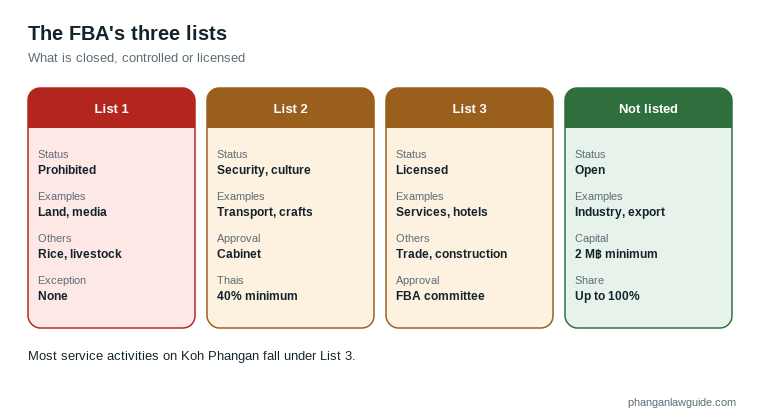
The 1999 FBA sorts activities into three lists:
- List 1: activities prohibited to foreigners (land trading, press and broadcasting, rice farming, livestock…), with no exceptions.
- List 2: activities tied to national security, culture or natural resources (domestic transport, Thai crafts…), possible with Cabinet approval and at least 40% Thai ownership.
- List 3: activities where Thais are "not yet ready" to compete, including most services, hotels (except hotel management), retail, construction and advertising. They require a licence.
An unlisted activity (manufacturing, export…) can be 100% foreign-owned, with 2 million baht of capital.
What are the legal routes to 100% foreign?
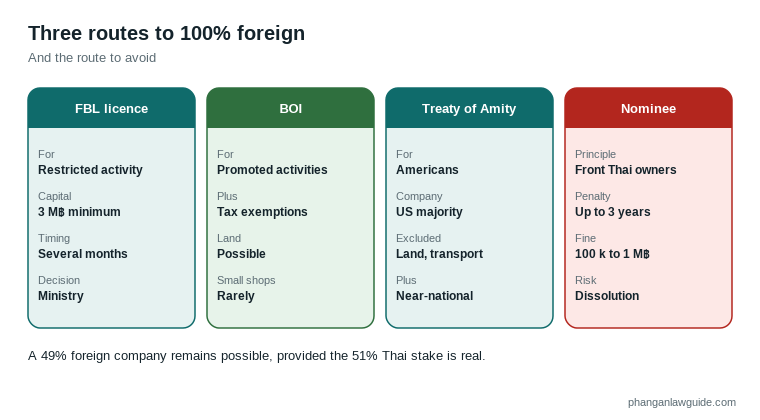
1. The FBL licence Applied for at the DBD, it is granted activity by activity, after review by the Foreign Business Committee. You must show the benefit to the Thai economy (jobs, know-how, investment). Minimum capital is 3 million baht, or 25% of the expected annual expenses over three years if higher. Timing runs to months, and the outcome is never guaranteed.
2. BOI promotion The Board of Investment promotes activities it wants to develop (manufacturing, technology, some large tourism projects). Promotion allows 100% foreign ownership, tax exemptions, visa and work permit facilities, and sometimes ownership of the land the project needs. It rarely suits a small business on the island.
3. The US Treaty of Amity Signed in 1966, it lets a company majority-controlled by Americans be treated almost like a Thai company for most List 3 activities. Exclusions include land ownership, transport, communications and some financial services.
What if you stay at 49%?
It is the most common solution, and it is legal if the 51% Thai stake is real: partners who invest their own money and take part in decisions. It becomes a nominee structure when the Thais are only names on a register.
The law punishes the nominee and the foreigner: up to 3 years in prison, 100,000 to 1 million baht in fines, a daily fine while the offence continues, and possible dissolution of the company. On Koh Phangan, the 2025 and 2026 operations targeted dozens of companies and villas.
Frequently asked questions
What is a Foreign Business License?
A licence issued by the Ministry of Commerce allowing a foreign-majority company to carry on a restricted List 2 or List 3 activity.
What capital does an FBL require?
At least 3 million baht, or 25% of average expected annual expenses over three years if higher.
Does the Treaty of Amity apply to Europeans?
No. It is reserved for US citizens and US companies.
Does BOI promotion allow buying land?
It can allow it for the needs of the promoted project, under conditions. It is not a general right to own land.
Is a 49% foreign company legal?
Yes, if the Thai shareholders are genuine investors. It becomes illegal if they are nominees.
What is the penalty for a nominee structure?
Up to 3 years in prison and a 100,000 to 1 million baht fine, for the nominee and the foreigner alike.
Sources
- ThaiLawOnline: the Foreign Business Act
- Tilleke & Gibbins: minimum capital for foreign companies
- Legal 500: the Foreign Business License
- ASEAN Briefing: restricted sectors and legal routes
- ThaiLawOnline: foreign ownership restrictions and the Treaty of Amity
- DBD: 2025 annual report of the Foreign Business Commission
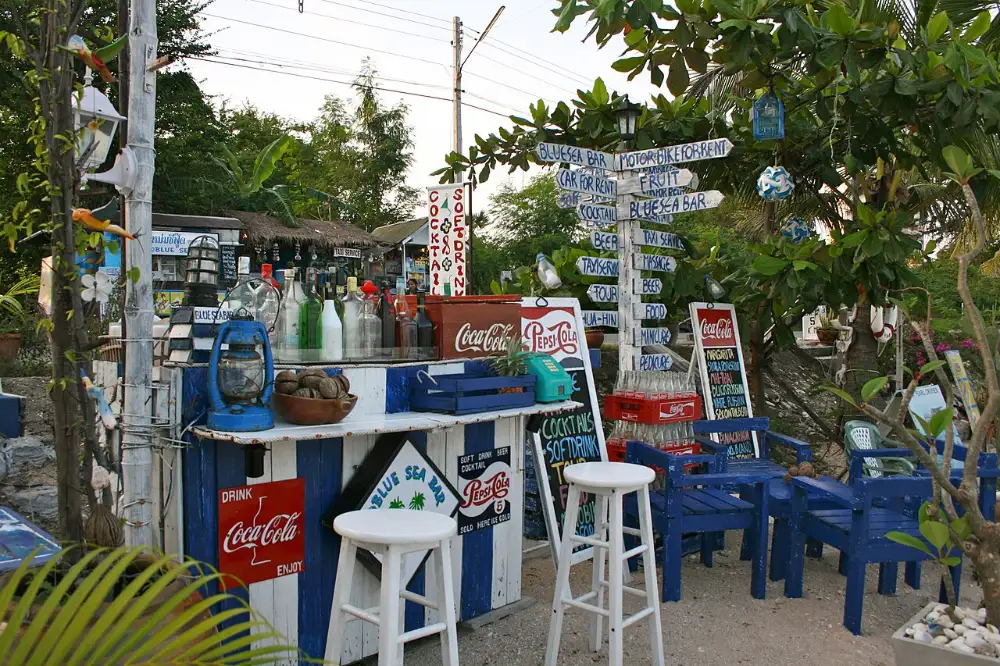
- Photo: resort on Koh Phangan, kallerna, CC BY-SA 4.0, Wikimedia Commons.
Share
Related guides
 BusinessSetting up a Thai companyAt least 2 shareholders, 49% foreign for restricted activities, 2 million baht per work permit: how to set up a…
 BusinessNominee crackdown 2025–2026Why Thailand is raiding nominee companies on Koh Phangan: figures, penalties, how investigators work and what villa…
 BusinessVAT and accounting for a company7% VAT above 1.8 million baht, 20% corporate tax (less for SMEs), withholding tax, audited accounts every year: the…
 BusinessExpat tax: the 180-day ruleThai tax residence at 180 days, foreign income taxed when brought in since 2024, pre-2024 savings, the 0–35% scale…