VAT, corporate tax and accounting in Thailand: what a company on Koh Phangan must do

On this page6
Emma runs two rental villas in Haad Yao through her Thai company. Turnover exceeds 1.8 million baht in the first high season, but nobody warned her. Eighteen months later, a tax audit claims the VAT she never charged, with fines and surcharges.
VAT you didn't charge can't be recovered from guests who have left: the company pays it.
When must you register for VAT?
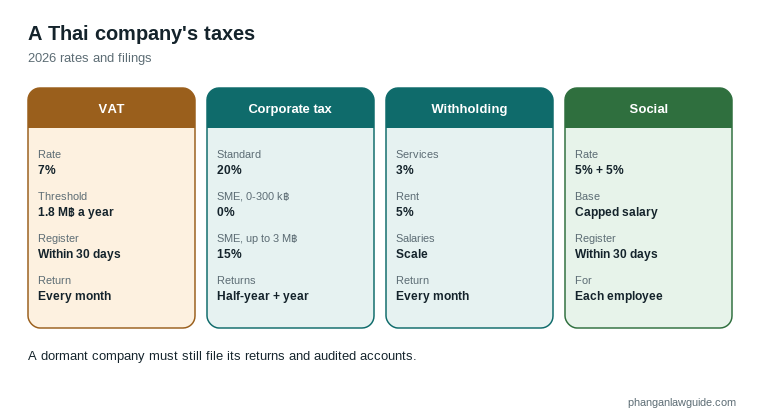
- Threshold: 1.8 million baht of annual turnover (about 150,000 baht a month).
- Deadline: registration within 30 days of crossing it. Voluntary registration is possible below.
- Rate: 7%, a reduced rate extended to 30 September 2027 (the statutory rate is 10%).
- Return: every month, by the 15th of the following month (the 23rd online), even if no VAT is due.
Some activities are exempt, notably renting out homes for residential use. Nightly tourist rentals are generally subject to VAT.
How much tax on profits?
- Standard rate: 20% of taxable profit.
- SMEs (paid-up capital up to 5 million and turnover up to 30 million baht): 0% on the first 300,000 baht, 15% up to 3 million, 20% above.
- Two returns: a half-year prepayment (PND51) and the annual return (PND50), within 150 days of year-end.
Dividends paid to shareholders also bear a 10% withholding tax.
What are the monthly obligations?
- VAT (PP30) if the company is registered.
- Withholding tax: the company withholds and remits 3% on services it pays for, 5% on rent, and tax on salaries according to the scale.
- Social security: 5% paid by the employer and 5% by the employee, on a capped salary. Registration within 30 days of the first hire.
What are the yearly obligations?
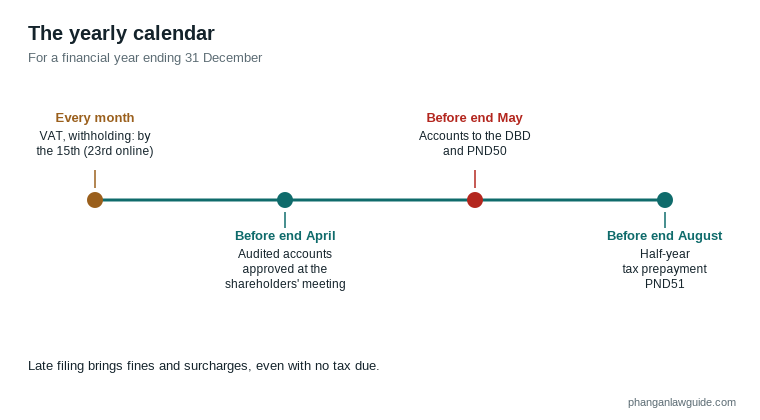
- Audited accounts: every company, however small or dormant, has its accounts certified by a licensed auditor (CPA).
- Meeting: accounts approved within 4 months of year-end.
- DBD filing: within 1 month of the meeting, with the shareholder list (BOJ.5) within 14 days.
- Annual corporate income tax return (PND50).
A dormant company isn't exempt: it must file its returns and accounts. Late filing brings fines and a 1.5% monthly surcharge on tax paid late.
Frequently asked questions
What is the VAT threshold in Thailand?
1.8 million baht of turnover a year. Registration must happen within 30 days of crossing it.
What is the VAT rate in 2026?
7%, a reduced rate extended to 30 September 2027.
What is the corporate income tax rate?
20%, with reduced SME rates: 0% up to 300,000 baht of profit and 15% up to 3 million.
Does a small company need audited accounts?
Yes. In Thailand, every private limited company has its accounts audited each year.
Must you file VAT in months with no turnover?
Yes. The monthly return is mandatory even with no VAT to pay.
What happens if a company doesn't file its accounts?
Fines for the company and its directors, and difficulties when closing or selling it.
Sources
- The Thaiger: 2026 figures (VAT, corporate tax)
- Forvis Mazars: VAT in Thailand, registration and invoices
- Thairath: SME VAT, threshold and monthly returns
- PwC: other corporate taxes in Thailand
- Accounts OS: audited accounts and annual DBD filings (Nov 2026)
- Photo: working on a laptop, perzon seo, CC BY 2.0, Wikimedia Commons.
Share
Related guides
 BusinessSetting up a Thai companyAt least 2 shareholders, 49% foreign for restricted activities, 2 million baht per work permit: how to set up a…
 BusinessExpat tax: the 180-day ruleThai tax residence at 180 days, foreign income taxed when brought in since 2024, pre-2024 savings, the 0–35% scale…
 BusinessRenting your villa to tourists: licence or not?Short-term rentals on Koh Phangan: the 8-room, 30-guest threshold, non-hotel notification, hotel licence, condos,…
 BusinessFBL, BOI, Treaty of Amity: 100% foreignThe three legal routes for a foreigner to hold a majority of a Thai company: FBL licence (3 million baht), BOI…