Expat tax on Koh Phangan: 180 days, money brought in and filing

On this page6
Natalie, a freelance designer, has lived in Srithanu since February. By August she had spent 190 days on the island, and every month she transfers 80,000 THB from her UK account to live on. She thought she owed nothing in Thailand, since her clients are in Europe. She has just found out she is a Thai tax resident for 2026, and that the money she brings in is taxable.
Since 2024, the Thai tax treatment of expats has changed, and many island residents still do not know it. The good news: with a little organisation, the tax is often low, or even zero.
When do you become a Thai tax resident?
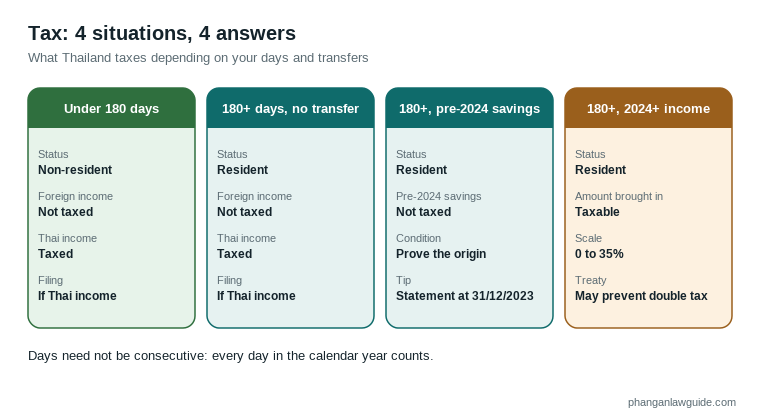
One number decides everything: 180 days. If you spend 180 days or more in Thailand during the calendar year (1 January to 31 December), you are a tax resident for that year. The days need not be consecutive, and the visa type changes nothing: DTV, retirement, exemption or marriage.
Below 180 days you are a non-resident: only your Thai-source income is taxed in Thailand.
Tax residence simulator
180 days in Thailand in a calendar year, and the money you bring in.
Indicative simulation only, not a substitute for advice from a licensed lawyer or accountant.
Which foreign income has been taxed since 2024?
Before 2024, a resident was only taxed on foreign income brought into Thailand in the same year it was earned. Since 1 January 2024 (instructions Por. 161/2566 and 162/2566), any foreign income earned from 2024 onwards becomes taxable in the year it enters Thailand, even years later.
In practice:
- Money left abroad and spent with a foreign card: not taxed in Thailand as long as it is not transferred.
- Pre-2024 savings: not taxable, provided you can prove they existed on 31 December 2023 (a bank statement at that date). Keep these savings in a separate account.
- 2024+ income brought in: taxable on the Thai scale, subject to the tax treaty between your country and Thailand, which may give the taxing right to one country only or allow a tax credit.
A relief measure for remitted income was discussed, but it has not been passed: the current rules apply to the whole of 2026.
How much tax will you pay?
Net taxable income (after allowances) follows the progressive scale, the same for Thais and foreigners:
| Net income (THB) | Rate |
|---|---|
| 0 to 150,000 | 0% |
| 150,001 to 300,000 | 5% |
| 300,001 to 500,000 | 10% |
| 500,001 to 750,000 | 15% |
| 750,001 to 1,000,000 | 20% |
| 1,000,001 to 2,000,000 | 25% |
| 2,000,001 to 5,000,000 | 30% |
| Over 5,000,000 | 35% |
Every taxpayer gets a personal allowance of 60,000 THB, and employment income gets a standard 50% deduction capped at 100,000 THB. People aged 65 or over get an extra allowance. The first 150,000 THB of net income is untaxed.
How and when do you file?
- Apply for a tax ID at the Revenue Department, with your passport and address.
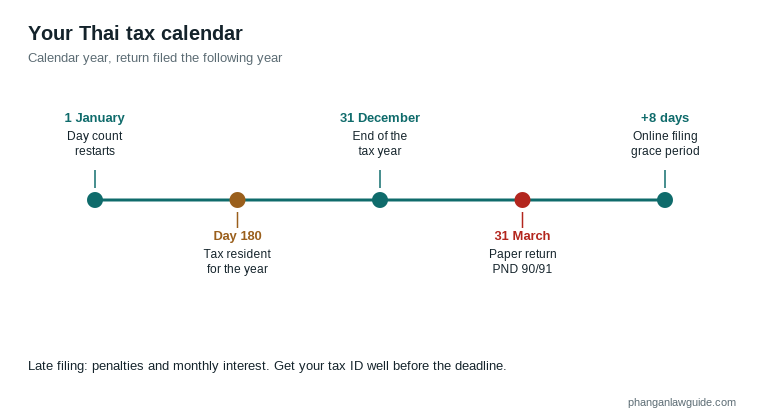
- Choose the form: PND 91 if you only have salary, PND 90 if you have other income (freelance, rent, pensions, dividends, remitted foreign income).
- File the return for year N by 31 March N+1 on paper; online filing gets 8 extra days.
- Pay any tax due. Late filing brings penalties and monthly interest.
Rent from property in Thailand is Thai-source income: it is taxable even if you are a non-resident.
Frequently asked questions
How many days make you a Thai tax resident?
180 days of presence in the calendar year, consecutive or not, whatever your visa.
Is foreign income taxed in Thailand?
For a tax resident, yes: since 2024, foreign income earned from 1 January 2024 is taxable in the year it enters Thailand, subject to tax treaties. Income left abroad is not taxed in Thailand.
Are pre-2024 savings taxable?
No, if you can prove they existed on 31 December 2023, for example with a bank statement at that date.
What are Thailand's income tax rates?
From 0% up to 150,000 THB of net income to 35% above 5 million THB, in eight bands.
When must you file a Thai tax return?
By 31 March of the following year on paper, with 8 extra days for online filing.
Is the remitted-income exemption in force?
No. The proposal was not passed: the 2024 rules apply to 2026.
Sources
- ThaiLawOnline: foreign income remittance tax in 2026
- The Thaiger: income tax for foreigners, 180 days and the remittance rule
- PwC: Thai personal income tax rates
- Forvis Mazars: personal income tax allowances and deductions
- Expatica: filing taxes in Thailand in 2026
- Zagdim: foreign-income relief bill stalls, rules unchanged for 2026
Share
Related guides
 BusinessVAT and accounting for a company7% VAT above 1.8 million baht, 20% corporate tax (less for SMEs), withholding tax, audited accounts every year: the…
 BusinessFBL, BOI, Treaty of Amity: 100% foreignThe three legal routes for a foreigner to hold a majority of a Thai company: FBL licence (3 million baht), BOI…
 BusinessSetting up a Thai companyAt least 2 shareholders, 49% foreign for restricted activities, 2 million baht per work permit: how to set up a…
 VisasDTV visa: the 2026 rulesDTV visa: 500,000 THB, 180 days per entry, criminal record required since 31 Aug. 2026. Who qualifies, what it…