Selling your condo, villa or lease in Thailand: taxes, assigning the lease and repatriating the price

On this page5
Paul bought a condo in Thong Sala three years ago for 4 million baht. He finds a buyer at 5 million and expects to pocket a million. At the land office he discovers the 3.3% specific business tax (he's selling within 5 years), his share of the transfer fee and withholding tax. And his bank asks for the FET form from the purchase, which he has lost, to send the price to Europe.
A sale is prepared from the day you buy: entry documents determine the exit.
What does a sale cost?
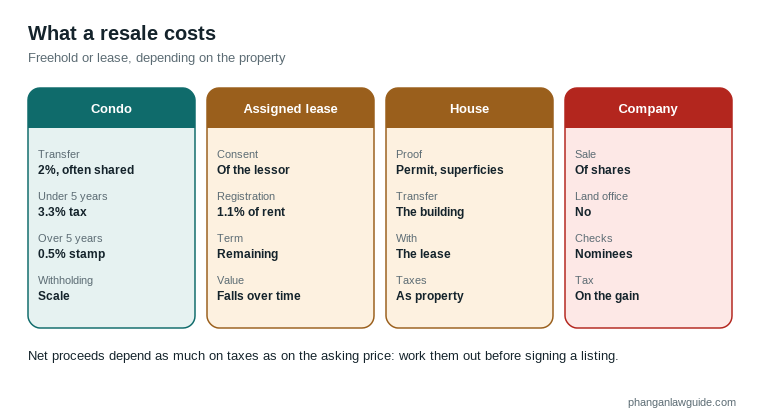
A freehold condo or land - Transfer fee: 2% of the appraised value, often shared between seller and buyer. - Specific business tax: 3.3% if sold less than 5 years after purchase. - Stamp duty: 0.5%, only if the specific business tax doesn't apply. - Withholding tax: based on the scale and holding period for an individual, 1% for a company.
An assigned lease - The lessor's consent, if the lease requires it or doesn't provide for assignment. - A new registration: 1.1% of the remaining rent. - A value that falls over time: a 30-year lease is worth less with 18 years left.
A house on leased land It transfers with the lease, based on the building permit or superficies registered in your name.
How does a sale unfold?
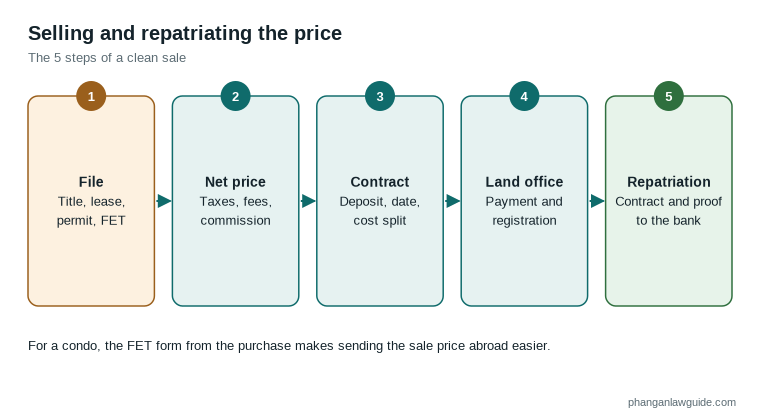
- Gather the file: title or registered lease, building permit, superficies, FET form, land tax receipts.
- Work out the net price: taxes, transfer fee, agent's commission, legal fees.
- Sign a contract: price, deposit, transfer date, cost split.
- Go to the land office: taxes paid and registration on the same day.
- Repatriate the price: your bank may ask for the sale contract and proof of transfer.
What if a company holds the property?
Some sellers offer to sell the company's shares rather than the property, to avoid the land office. It isn't a tax-free route: the gain on the shares is taxable, and the buyer takes on the company's whole history. If the structure relies on nominees, the buyer also inherits the criminal risk.
Frequently asked questions
What taxes do you pay when selling property in Thailand?
The transfer fee (2%), specific business tax (3.3% within 5 years) or stamp duty (0.5%), and withholding tax on the gain.
Can a foreigner sell their lease?
Yes, for the remaining term, with the lessor's consent if the lease requires it, and a new 1.1% registration.
How do you repatriate the sale price?
By bank transfer, with the sale contract and proof of transfer; for a condo, the FET form from the purchase eases it.
How long must you hold to avoid the specific business tax?
5 years from acquisition, or one year registered in the Tabien Baan for an individual living there.
Can you sell the company that holds the villa?
Yes, but the gain is taxable and the buyer takes on all the company's risks.
Can a house built on leased land be sold?
Yes, with the lease, if you can prove it's yours (building permit, superficies).
Sources
- Expatica: selling property in Thailand and repatriating the price
- Expat Focus: taxes and the FET form on resale
- Lex Bangkok: selling a villa, asset sale or share sale
- Global Investments: exit taxes and selling a lease
- Chambers: 1.1% registration for a lease
Share
Related guides
 PropertyBuying costs and taxes: who pays what?A 2% transfer fee, 3.3% business tax or 0.5% stamp duty, 1.1% to register a lease, yearly land tax: the real cost of…Property30+30+30 leases after 4655/2566Is a 30+30+30 lease still valid? What Supreme Court ruling 4655/2566 means for Koh Phangan villas, options for…
 PropertySuperficies and usufruct: owning your houseA foreigner can't own land but can own their house: superficies, usufruct, habitation and leases, and what each…
 PropertyBuilding your villa: permits and zonesA building permit (Or. 1) in your name, altitude zones, 35% slopes, a 6 m height cap: what a foreigner must know…