Property scams on Koh Phangan: the 8 traps that cost foreigners the most
On this page6
Thomas found "the plot of his life" above Haad Yao: sea view, fair price, a friendly seller, a fellow countryman settled for ten years. He is asked for a 300,000 baht deposit "to hold it before another buyer". He pays in cash. At the land office he then learns that the title is only a possession right, that the plot spills into a forest reserve and that the seller never owned it.
None of this was hidden: he only had to check before paying.
Why does Koh Phangan attract scams?
The island has everything that makes fraud easy: rising prices, many foreign buyers in a hurry, old plots with weak titles, hills classed as forest and beaches that remain public land.
- Trust between compatriots: according to the law firm House Condo Lawyer, quoted by the Bangkok Post, over 60% of property fraud cases in Thailand involve a fellow national of the victim.
- Occupied public land: in September 2026, the Thai press ran a feature on Laem Son, a former mining area where businesses have operated for more than 30 years without title deeds.
- The nominee crackdown: since 2025, raids on the island have multiplied, including one operation targeting 24 sites, among them luxury villas in Chaloklum.
What are the 8 most common traps?
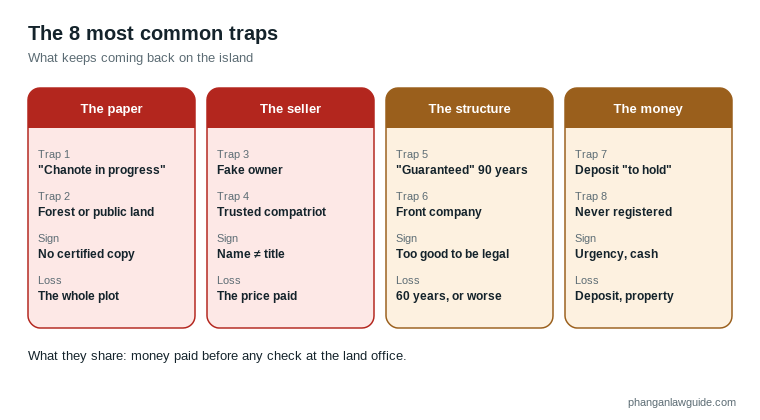
- The title "in progress": "the Chanote is coming soon". A Por Bor Tor 5 (tax receipt) or a Sor Kor 1 (possession notice) makes you owner of nothing.
- Forest or public land: part of the plot overlaps a forest reserve, a beach or a former concession. It can never be titled.
- The fake owner: the seller isn't the person named on the title, or acts under a dubious power of attorney.
- The trusted compatriot: they speak your language, know "the right notary", and advise against a lawyer as "pointless".
- The "guaranteed" 90-year lease: since ruling 4655/2566, only the first 30 years are truly protected.
- The front Thai company: a company where Thai shareholders hold 51% without investing anything. That is exactly what nominee prosecutions target.
- The deposit "to hold it": paid in cash, with no reviewed contract, under pressure from an imaginary other buyer.
- The developer who never registers: you pay for a villa or a flat off-plan, but the lease or transfer is never recorded. On Koh Samui, one buyer waited in vain for a 15 million baht property to be registered.
How do you protect yourself before paying?
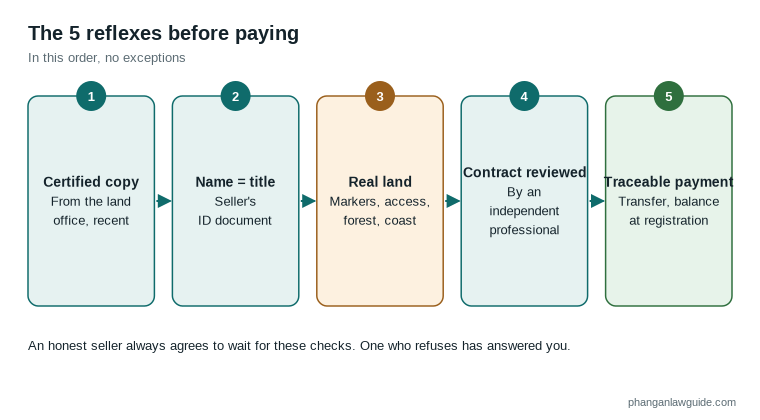
Five reflexes rule out most scams, and an honest seller always accepts them:
- A recent certified copy of the title, requested by you at the land office, front and back.
- The seller's name matching the title, checked against their ID.
- The actual land: boundary markers, legal access, distance to forest, beach and watercourses.
- A contract reviewed by an independent professional, working neither for the seller nor the agent.
- A traceable payment: by bank transfer, with the balance paid on the day of registration at the land office.
What if you think you've been scammed?
- Stop all payments and sign nothing more.
- Gather the evidence: contracts, receipts, messages, title copies, transfer statements.
- Have the title checked at the land office to learn the real situation.
- Act fast: some claims have short deadlines, and a dishonest seller may resell or disappear.
The Thai police and the DSI (a Thai equivalent of the FBI) take reports. The DSI itself warns never to trust anyone claiming they can help a foreigner legally hold a land title in Thailand.
Frequently asked questions
What is the most common property scam in Thailand?
Paying a deposit before any check of the title at the land office, often under pressure and on the advice of a compatriot.
How do you check a land title is genuine?
Request a recent certified copy yourself from the Koh Phangan land office, front and back, and compare it with the seller's document.
Can beachfront land be titled?
Not the part on the beach or in the public coastal strip. It remains public land, even if occupied for a long time.
Can you buy land with a Por Bor Tor 5?
No. It is only a land tax receipt, which proves no ownership and cannot be transferred.
What should you do after paying a deposit to a fake seller?
Stop all payments, gather the evidence, have the title checked and file a complaint quickly.
Is a long-settled compatriot a sign of trust?
No. According to a law firm quoted by the Bangkok Post, over 60% of property fraud involves a fellow national of the victim.
Sources
- Bangkok Post: over 60% of fraud cases involve fellow nationals
- Nation Thailand: the Laem Son land dispute on Koh Phangan (6 Sept 2026)
- Nation Thailand: operation on 24 sites, including villas in Chaloklum
- Khaosod English: the Prime Minister on Koh Phangan's public beaches
- DSI: warning about foreigners holding land titles
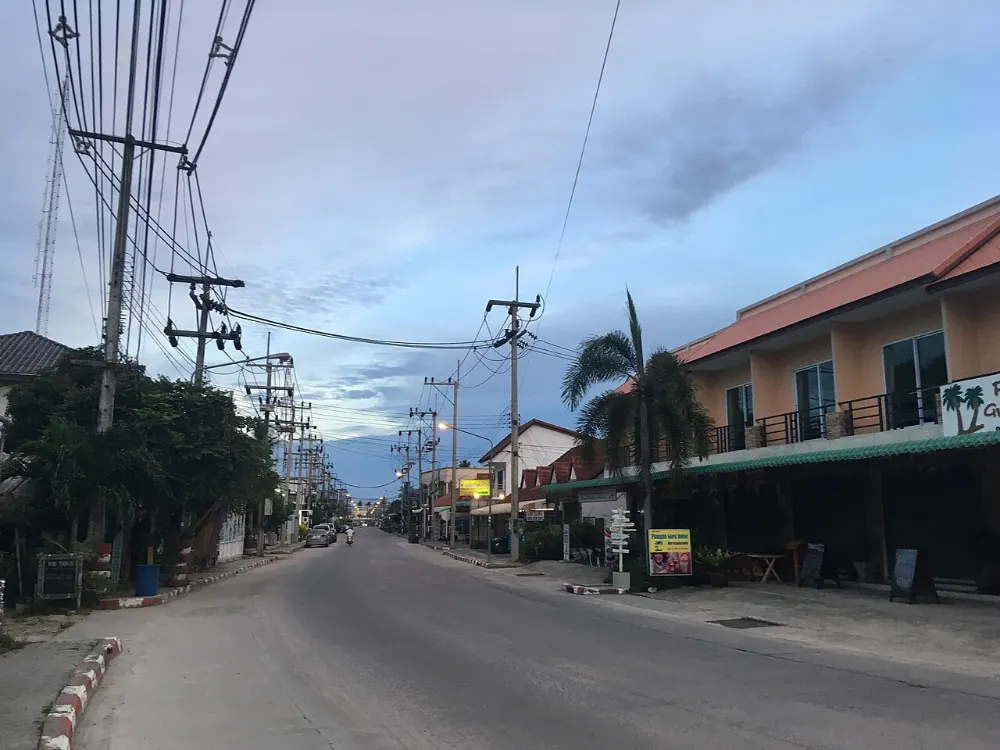
- Photo: road in Thong Sala, Christophe95, CC BY-SA 4.0, Wikimedia Commons.
Share
Related guides
 PropertyChanote vs Nor Sor 3 Gor: which land title?Chanote, Nor Sor 3 Gor, Nor Sor 3, Sor Kor 1, Por Bor Tor 5: what each Thai land document is worth on Koh Phangan,…
 PropertyCheck a property before you buyFree tool: check the title, seller, access, forest, structure and payment before you buy or lease on Koh Phangan.…
 BusinessNominee crackdown 2025–2026Why Thailand is raiding nominee companies on Koh Phangan: figures, penalties, how investigators work and what villa…
 PropertyBuilding your villa: permits and zonesA building permit (Or. 1) in your name, altitude zones, 35% slopes, a 6 m height cap: what a foreigner must know…