Registered lease in Thailand: 30 years maximum, and why to register it

On this page4
"90-year lease, signed at the lawyer's." In Thailand that paper is worth only what the land office says: 30 years at most, and only if registered.
What is a registered lease?
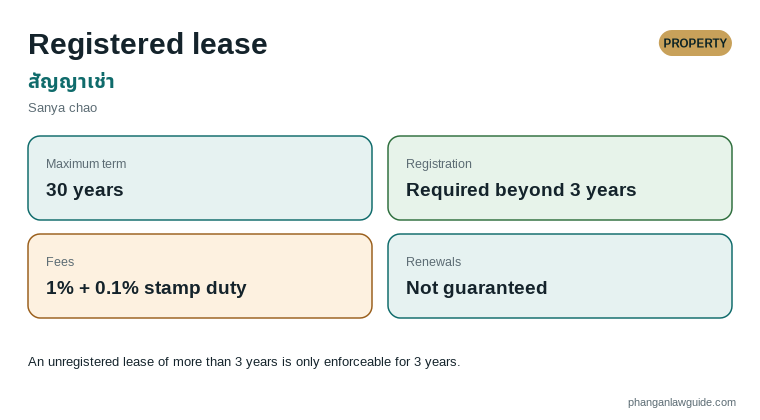
A lease lets a foreigner use land or a house they cannot own. The Civil and Commercial Code sets two rules: beyond 3 years, the lease must be in writing and registered at the land office to be fully valid (section 538); its term cannot exceed 30 years (section 540).
A registered lease appears on the back of the land title. It binds any future buyer of the land. Registration fees are 1% of the total rent for the period, plus 0.1% stamp duty.
Why does it matter on Koh Phangan?
Most villas sold to foreigners on Koh Phangan are sold on leasehold. "30+30+30" renewal promises remain a mere contractual undertaking: the Supreme Court held that renewals agreed in advance do not bind beyond 30 years.
Frequently asked questions
How long can a lease last in Thailand?
30 years at most. A longer term is reduced to 30 years.
Do you have to register a lease?
Yes, beyond 3 years. Otherwise the lease is only valid for 3 years and does not protect you against a new owner.
Is a 30+30+30 lease valid?
For the first 30 years, if registered. Renewals agreed in advance are not guaranteed since ruling 4655/2566.
Sources
- Chambers: leases, sections 538 and 540 CCC and ruling 4655/2566
- Global Law Experts: lease, usufruct and superficies compared
Share
Related guides
GlossarySuperficies: definitionThe right of superficies (sections 1410 to 1416) lets a foreigner own a house built on Thai land: term, registration… GlossaryUsufruct: definitionUsufruct (sections 1417 to 1428) gives the right to use property and take its income, often for life: what it…GlossaryChanote: definitionThe Chanote (Nor Sor 4 Jor) is the only true freehold land title in Thailand: what it proves, how to recognise it…Property30+30+30 leases after 4655/2566Is a 30+30+30 lease still valid? What Supreme Court ruling 4655/2566 means for Koh Phangan villas, options for…