FET form: the transfer proof you need to buy a condo in Thailand

On this page4
The condo is chosen, the price agreed, the money sent. At the land office, the officer asks for the FET… which the bank never issued because the money arrived in baht.
What is the FET form?
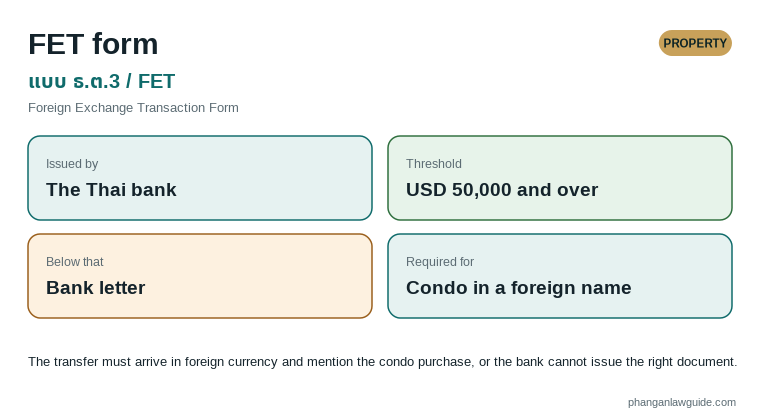
For a foreigner to own a condo, the law requires the price to be paid with money from abroad, in foreign currency. The proof is the FET, issued by the Thai bank that converts the funds.
The form states the amount, currency, sender and purpose of the transfer. For amounts below USD 50,000, the bank provides a letter or credit advice that serves the same purpose.
Why does it matter on Koh Phangan?
Condos are scarce on the island, and foreign buyers often pay in several transfers or through an intermediary. A transfer arriving in baht, or without the right reference, can block registration in the buyer's name.
Frequently asked questions
What is the FET form?
A Thai bank document proving that a foreign-currency transfer came from abroad. It replaces the old Thor Tor 3.
Is the FET required to buy a condo?
To register a condo in a foreigner's name, you must prove the foreign origin of funds: the FET, or a bank letter for smaller amounts.
What if the money arrived in baht?
Contact the bank quickly. Without proof of a foreign-currency transfer, registration in the foreigner's name may be refused.
Sources
- Terms.law: the 49% foreign quota and section 19 of the Condominium Act
- Global Law Experts: transferring a condo to a foreign buyer
Share
Related guides
 GlossaryRegistered lease: definitionA lease of more than 3 years must be registered at the Thai land office and cannot exceed 30 years: the rules, the…GlossaryChanote: definitionThe Chanote (Nor Sor 4 Jor) is the only true freehold land title in Thailand: what it proves, how to recognise it…
 GlossaryTabien Baan: definitionThe Tabien Baan is the house registration of a home in Thailand: blue book for Thais, yellow book (Tor Ror 13) for…PropertyBuying a condo: the 49% quotaA foreigner can own a Thai condo freehold: the 49% quota, the foreign-currency transfer and FET form, the 2% fee,…