Overstay in Thailand: fines, re-entry bans and what to do if you've overstayed your visa

On this page6
Hugo arrives on Koh Phangan visa-exempt. He mixes up his entry date and his deadline, and realises three weeks late that he has overstayed. He hesitates: leave now, or finish the season and "pay at the airport"? One evening, a routine check in Haad Rin looks at passports.
That check changes everything: what would have cost a 10,500 baht fine becomes an arrest and a 5-year ban.
How much does an overstay cost?
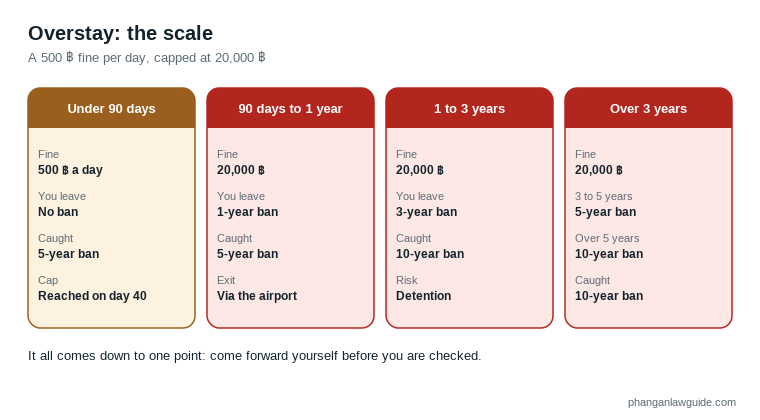
- The fine: 500 baht per day of overstay, with no grace period. The day after your deadline counts as day one.
- The cap: 20,000 baht, reached on day 40.
- Payment: in cash, at the immigration counter, before passing exit control.
Some examples: 1 day, 500 baht; 7 days, 3,500 baht; 30 days, 15,000 baht; 40 days or more, 20,000 baht.
When do you risk a re-entry ban?
The scale depends on how your situation comes to light. It is set by an Interior Ministry order applied since 20 March 2016.
If you come forward yourself to leave: - under 90 days: fine only, no ban; - over 90 days: 1-year ban; - over 1 year: 3 years; - over 3 years: 5 years; - over 5 years: 10 years.
If you're caught before leaving: - under 1 year: 5-year ban; - over 1 year: 10 years.
The ban starts on the day you leave. An arrest can also mean a court appearance, detention at the immigration centre and deportation at your own expense.
You've overstayed: what now?
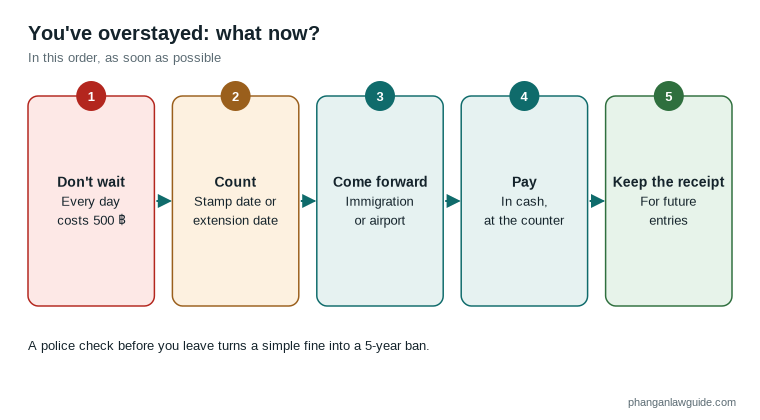
- Don't let it run: each day adds 500 baht, and each day on the island raises the risk of a check.
- Count the days from your last stamp or last extension.
- Come forward: at the Koh Phangan immigration office or at your departure airport.
- Pay the fine in cash and leave the country.
- Keep the receipt: you may be asked for it on a future entry.
An overstay, even short and paid, is recorded on your file. On a future entry, the officer may ask questions, and some visas (notably Thailand Privilege) look at past overstays.
Can you regularise without leaving the country?
In principle, an extension must be requested before the deadline. Once you've overstayed, immigration sometimes agrees, case by case, to process an application after the fine is paid, but nothing guarantees it. In case of illness or hospitalisation, keep the medical certificates: they may count in your favour.
Frequently asked questions
How much is the overstay fine in Thailand?
500 baht a day, up to a maximum of 20,000 baht, paid to immigration when you leave.
Does a few days' overstay lead to a ban?
No, if you come forward yourself and the overstay is under 90 days.
What happens if you're caught overstaying?
Possible detention, deportation and a re-entry ban of 5 years (under a year) or 10 years (over a year).
Can you pay the fine at the airport?
Yes, at the immigration counter before exit control, in cash.
Can a past overstay cause problems later?
It stays on your file. It can lead to questions on entry or complicate some visa applications.
Does your last day count as overstay?
No. The overstay starts the day after your deadline, weekends and public holidays included.
Sources
- Official Thai government portal: overstay fines
- Royal Thai Embassy: measures in force since 20 March 2016
- Pattaya Mail: immigration explains fines and bans
- The Thaiger: the ban scale under order 1/2558
- Fragomen: re-entry bans for overstayers
Share
Related guides
VisasVisa-free stay cut to 30 daysSince 15 Sept. 2026 Thailand gives 30 days visa-free, not 60. Who is concerned, how to extend on Koh Phangan,… VisasTM30 and the 90-day reportTM30 within 24 hours by the host, the 90-day report (TM47) online or in person, travel and moving house, fines of…
 VisasThailand Privilege visa (Elite)From 650,000 to 5 million baht, 5 to 20 years: what the Thailand Privilege visa allows, what it doesn't (working),…
 DisputesArrested in Thailand: your rights48 hours in police custody, court-ordered detention of up to 84 days, the right to a lawyer and interpreter, bail,…