LTR visa in Thailand: 10 years' residence, lighter taxes and a work permit, who qualifies and on what terms

On this page6
Pierre, 58, receives $90,000 a year in pensions and dividends. Living on the island more than 180 days a year, he discovers that money he brings into Thailand has been taxable since 2024. A friend tells him about the LTR visa: ten years' stay, and his foreign income exempt.
For a wealthy retiree, the LTR changes both status and tax. But thresholds are high, and everything depends on the category.
What is the LTR visa?
Launched in 2022 by the Board of Investment (BOI), the LTR targets "high-potential" foreigners. It offers:
- 10 years' stay, in two 5-year periods, with multiple entries;
- one report a year to immigration instead of every 90 days;
- spouse and children as dependents;
- a digital work permit for categories that work;
- exemption from the 4 Thais per foreign employee ratio;
- tax benefits depending on the category.
The fee is 50,000 baht per person, once for the 10 years. The requirements were eased in 2025, and many guides still show the old thresholds.
What are the 4 categories?
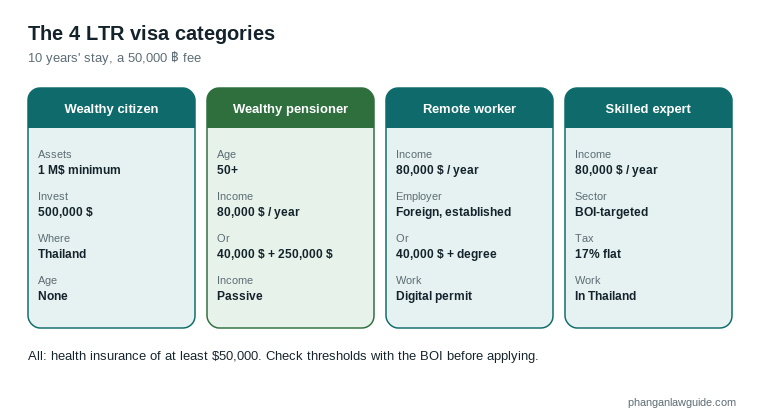
- Wealthy global citizen: at least $1 million in assets, with $500,000 invested in Thailand (property, bonds, shares), and high income. No age requirement.
- Wealthy pensioner: 50+, retired, with $80,000 of passive income a year, or $40,000 plus $250,000 invested in Thailand. Salaries don't count.
- Remote worker: $80,000 of income a year, employed by an established foreign company (listed or with significant revenue), or $40,000 with a master's degree or intellectual property.
- Highly skilled professional: $80,000 of income a year (less for some public or BOI-promoted employers), in a targeted sector.
Every category requires health insurance of at least $50,000, or equivalent cover.
What does the LTR really change?
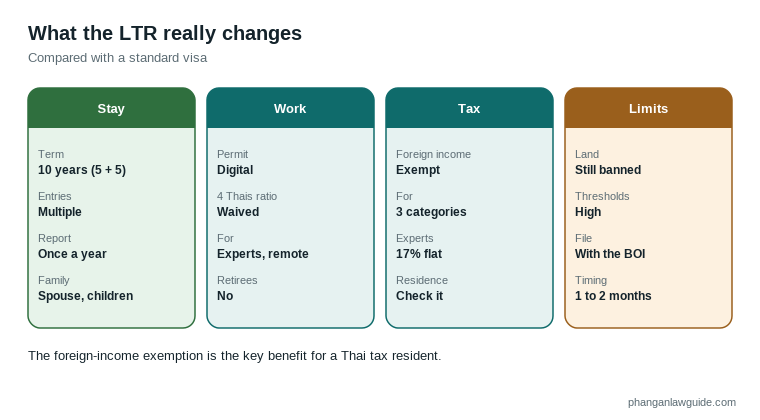
- Tax: wealthy citizens, wealthy pensioners and remote workers are exempt from Thai tax on foreign income, even when remitted. It is the key benefit since Thailand began taxing foreign income remitted by residents.
- Highly skilled professionals: a flat 17% rate on Thai employment income, instead of the progressive scale up to 35%.
- Work: a digital work permit for experts and remote workers. Retirees cannot work.
What the LTR doesn't change: the ban on foreigners owning land.
How do you apply?
- Choose the category that fits your situation.
- Gather proof: income over the last two years, statements, contracts, health insurance, investments.
- File online with the BOI, which issues an eligibility certificate.
- Get the visa from an embassy or the Bangkok service centre, then pay the 50,000 baht.
- Every year: file the annual report and keep meeting the conditions.
Processing usually takes one to two months.
Frequently asked questions
How much does the LTR visa cost?
50,000 baht per person, once for the 10 years.
What income do you need for an LTR visa?
Usually $80,000 a year, or $40,000 with an investment or degree depending on the category.
Does the LTR exempt you from Thai tax?
It exempts foreign income for wealthy citizens, wealthy pensioners and remote workers. Thai income remains taxable.
Can you work on an LTR visa?
Yes for skilled professionals and remote workers, with a digital permit. No for retirees.
Does the LTR let you buy a house?
It changes nothing about land ownership: condo or lease only.
Can your family come?
Yes: spouse and children can obtain dependent visas.
Sources
- BOI: official LTR visa brochure (2025)
- The Thaiger: LTR visa requirements and benefits
- Nation Thailand: the easing of LTR requirements
- HLB Thailand: 2026 updates to the LTR visa
- Thai Ministry of Foreign Affairs: LTR infographic
- Photo: bungalows at Haad Tien, Micha Schmidt, CC BY-SA 2.5, Wikimedia Commons.
Share
Related guides
 VisasThailand Privilege visa (Elite)Thailand Privilege (Elite) visa: 650,000 to 5 million baht, 5 to 20 years. What it allows, what it doesn't (work)…
 VisasRetirement visa: Non-O, O-A or O-X?Thailand retirement visa from 50: 800,000 THB or 65,000 THB a month, the deposit calendar, insurance, the 10-year…
 VisasDTV visa: the 2026 rulesDTV visa: 500,000 THB, 180 days per entry, criminal record required since 31 Aug. 2026. Who qualifies, what it…
 BusinessExpat tax: the 180-day ruleThai tax residence at 180 days, foreign income taxed when brought in since 2024, pre-2024 savings, the 0–35% scale…